It's 4:40 on a Thursday in March. The CPA needs last year's K-1s by Friday. The estate attorney is waiting on a signed trust amendment, the umbrella policy on the lake house renews Monday, and the principal's flight to Phoenix just moved. One person has to sort all of it out, and that person is the family's administrative assistant.
So what skills should a family office administrative assistant have? Seven matter most: discretion, document management, calendar and household coordination, financial and entity literacy, provider follow-through, clear communication, and security habits. Each one protects something the family can't easily replace.
From across the room, the job looks like corporate admin. Up close, nearly every task touches information the family would never want misplaced or shared with the wrong person. That makes this hire a trust decision as much as a skills decision.
It also means a strong assistant eventually needs structure behind them. Once a family owns several entities and works with a full bench of advisors, including those providing philanthropic planning services, one capable person can't hold every record and deadline in memory. A skilled assistant runs the day. The system behind that person is a separate job, and that's where structured family office administrative support comes in. It keeps documents organized and providers aligned, so follow-through doesn't hang on a single inbox.
TL;DR Quick Answers
Family Office Administrative Support
Family office administrative support is the structured system behind a high-net-worth family's paperwork. It keeps every key record in one secure source of truth, gives the CPA, attorney, and insurance advisor shared context, and drives open items to completion. It works alongside those advisors and never replaces them.
What it covers:
Document management: wills, trusts, tax returns, and titles kept current in one place
Electronic vault: encrypted storage with defined permissions and multi-factor access
Provider coordination: one point of contact tracking advisor action items and deadlines
Recurring workflows: entity records, signature and notary coordination, insurance renewals
The assistant's role: a skilled assistant runs the day inside the system, so follow-through never hangs on one inbox
When to act: documents sit in several inboxes, renewals slip, or one person holds every deadline in memory. Families with multiple entities, trusts, or residences usually reach that point first.
Top Takeaways
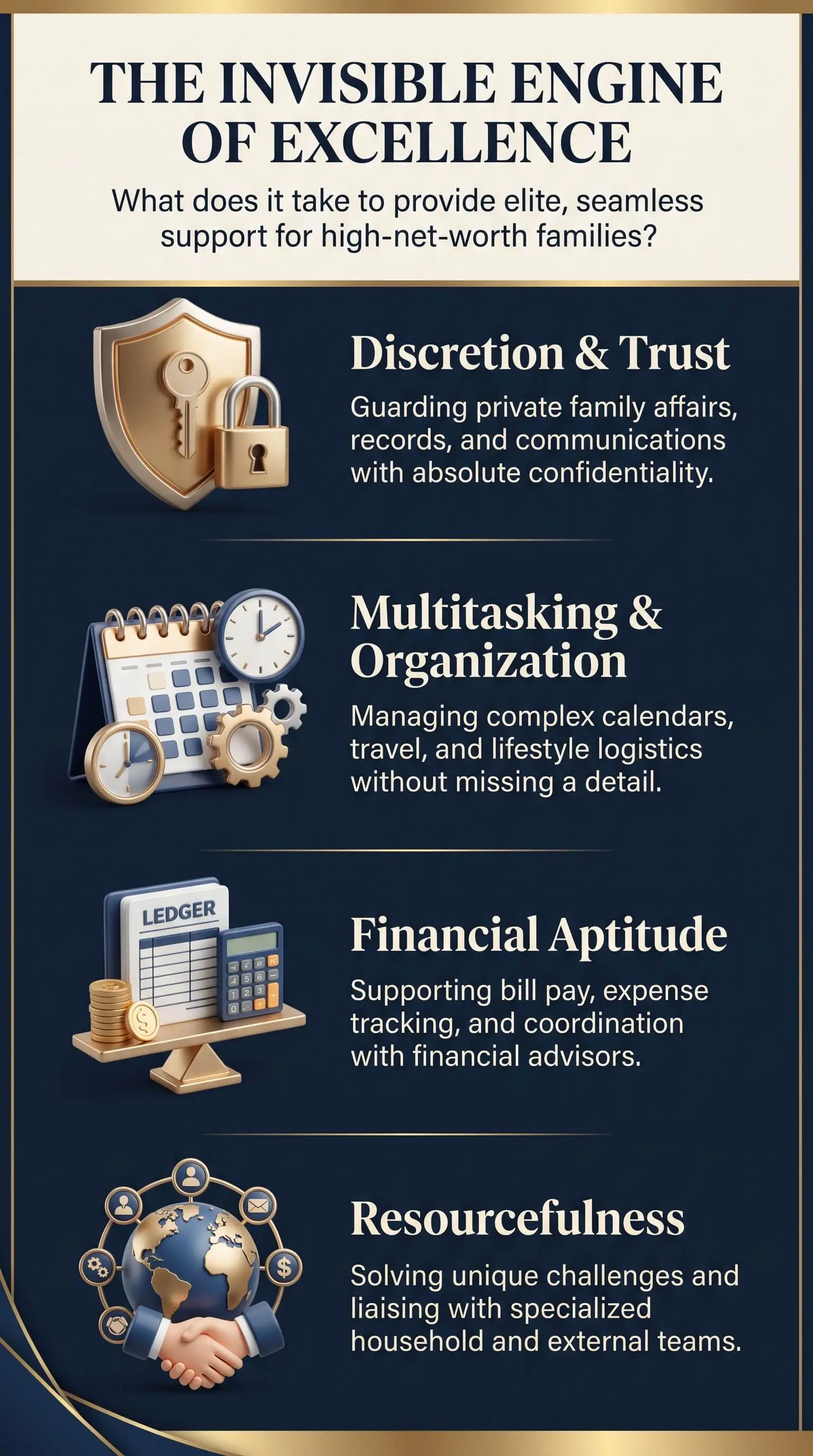
Seven skills define a strong family office administrative assistant: discretion, document management, calendar and household coordination, financial and entity literacy, provider follow-through, communication, and security fluency.
A family office assistant serves a whole family, often across generations, residences, and legal entities, which sets the job far apart from corporate admin.
Discretion holds up only when a process backs it, such as defined permissions and secure file sharing.
A structured interview scorecard with specific example questions tells you more than any resume.
Many family offices report cyberattacks, most often through phishing, so security now counts as an administrative skill.
When documents, entities, and advisors multiply, even a great assistant needs a system behind them.
What Does a Family Office Administrative Assistant Do?
A family office administrative assistant runs the personal and business administration for a high-net-worth family and its principal. The work covers calendars, correspondence, records, bills, and renewals, plus coordination with the family's outside advisors.
The position grew out of the traditional secretary role. Today the scope is wider and the stakes are more personal. A family office assistant may support three generations at once, across several households and legal entities.
Who they serve: On the corporate side, one executive or team. In a family office, the assistant answers to a principal, a spouse, adult children, and sometimes grandparents.
Information handled: Corporate assistants see business plans and internal data. Family office assistants handle tax returns, trusts, wills, property titles, and personal matters.
Scope of tasks: Meetings, travel, and reporting fill a corporate week. A family office week adds households, entities, renewals, and family events.
Stakeholders: A corporate assistant works with colleagues and clients. A family office assistant works with CPAs, estate attorneys, insurance advisors, property managers, and the family itself.
Privacy stakes: At a company, a leak is a confidentiality problem. In a family office, it can reach the family's safety, reputation, and wealth.
The 7 Essential Skills Every Family Office Assistant Needs
1. Discretion and Confidentiality
Discretion means sharing information only with people who need it, and only when they need it. In a family office, that covers everything from a net worth figure to a teenager's travel plans.
Good intentions won't carry this skill. Strong assistants follow defined permissions and consistent handling standards, and they move sensitive files through secure channels. They never forward a document "just to be helpful." They also know when to say nothing at all, whether at a dinner party or on social media.
2. Organization and Document Management
Document management gives the family one reliable source of truth for every important record. Wills, trusts, tax returns, deeds, titles, and insurance policies belong in one secure place, with clear names and current versions.
Here's a quick test. When the CPA asks for last year's K-1s, can the assistant find them in two minutes? A fragmented family file creates last-minute document hunts and duplicated work. During tax season or an estate update, and certainly in an emergency, that disorder costs real money.
3. Calendar, Travel, and Household Coordination
In a family office, calendar coordination means balancing business commitments against family life, often across time zones and more than one residence. A board meeting, a school recital, and a trust signing can all land on the same Tuesday.
The best assistants plan early and confirm every detail twice. They build buffer time into the schedule. They also keep household vendors, staff, private school schedules, and travel providers on track, so the principal never has to manage them.
4. Financial and Entity Literacy
Financial literacy in this seat means the assistant reads statements, bills, and deadlines well enough to route each one correctly. It stops short of financial advice, which stays with the family's licensed professionals.
A good assistant can tell an LLC operating account from a trust account at a glance. They catch the duplicate invoice, track the quarterly estimated tax deadline, and notice when a policy renewal never arrived. Small errors stay small.
5. Provider Coordination and Follow-Through
Provider coordination keeps the family's advisors working from shared context and drives each task to completion. Most families already have a good CPA, attorney, and insurance advisor. What's usually missing is the person who connects them.
The strongest assistants track every open action item and follow up before anyone asks. They gather documents ahead of the deadline. Your providers stay in their lanes, and the assistant keeps the lanes connected and moving.
6. Communication and Emotional Intelligence
Communication in a family office means representing the family well and reading the room. In a single hour, an assistant might speak with a banker, a roofing contractor, an aunt, and a portfolio company CEO.
Family dynamics add another layer. A skilled assistant stays neutral, keeps confidences between family members, and holds steady when a conversation turns difficult. It's the same people skill that leadership coaching for business leaders sets out to build, applied to a smaller and more personal team.
7. Technology and Security Fluency
Technology fluency means using modern tools well and using them safely. Most family offices run on Microsoft 365 or Google Workspace, alongside secure portals for banking, tax, and document storage.
Scammers target wealthy families with phishing and impersonation schemes. A strong assistant turns on multifactor authentication and confirms payment requests by phone. Any urgent wire request stays a red flag until someone verifies it.
Qualities That Separate Good From Great
You can teach skills. These qualities are much harder to train:
Judgment: knows which issue needs the principal today and which can wait until Monday.
Anticipation: solves the problem before anyone notices it.
Composure: stays steady when travel falls apart or a deadline moves.
Service orientation: does excellent work without needing credit for it.
Loyalty and longevity: stays for years and learns the full picture, which families value highly.
How to Evaluate a Family Office Assistant Candidate
A simple scorecard keeps interviews honest. Ask for specific examples, and push past general claims.
Discretion: Follows clear rules for sharing sensitive information. Ask: "Tell me about a time someone asked for information you couldn't share."
Document management: Keeps one organized, current source of records. Ask: "How would you organize a family's trust and tax documents from scratch?"
Coordination: Balances competing calendars and households. Ask: "Walk me through a week when three priorities collide."
Financial literacy: Routes bills and deadlines correctly. Ask: "How would you handle an invoice that doesn't match the vendor contract?"
Follow-through: Tracks advisor action items to completion. Ask: "How do you keep a CPA's open requests from slipping?"
Communication: Stays neutral and professional with family members. Ask: "How would you handle two family members giving you conflicting instructions?"
Security: Verifies requests before acting. Ask: "What would you do if you received an urgent wire request by email?"
Check references with the same care. Ask former employers directly about confidentiality and reliability, and find out how long the candidate stayed.
When One Assistant Isn't Enough
Even a great assistant can end up carrying more than one person should. Watch for these signs:
The family has multiple entities, properties, trusts, or residences.
Important documents sit in a dozen inboxes and advisor files.
Recurring tasks keep slipping, or someone handles them differently each time.
A strong advisor bench lacks consistent follow-through.
Everything depends on one person's memory.
At that point, "Who should we hire?" turns into "What system should support them?" Some families add staff. Others pair an assistant with an outside team for document management, electronic vault services, provider coordination, and repeatable workflows, and their administration moves from reactive to reliable. Families in the middle of a major transition often get the most from this setup, as our look at how an outsourced family office can help after the sale of a business explains.
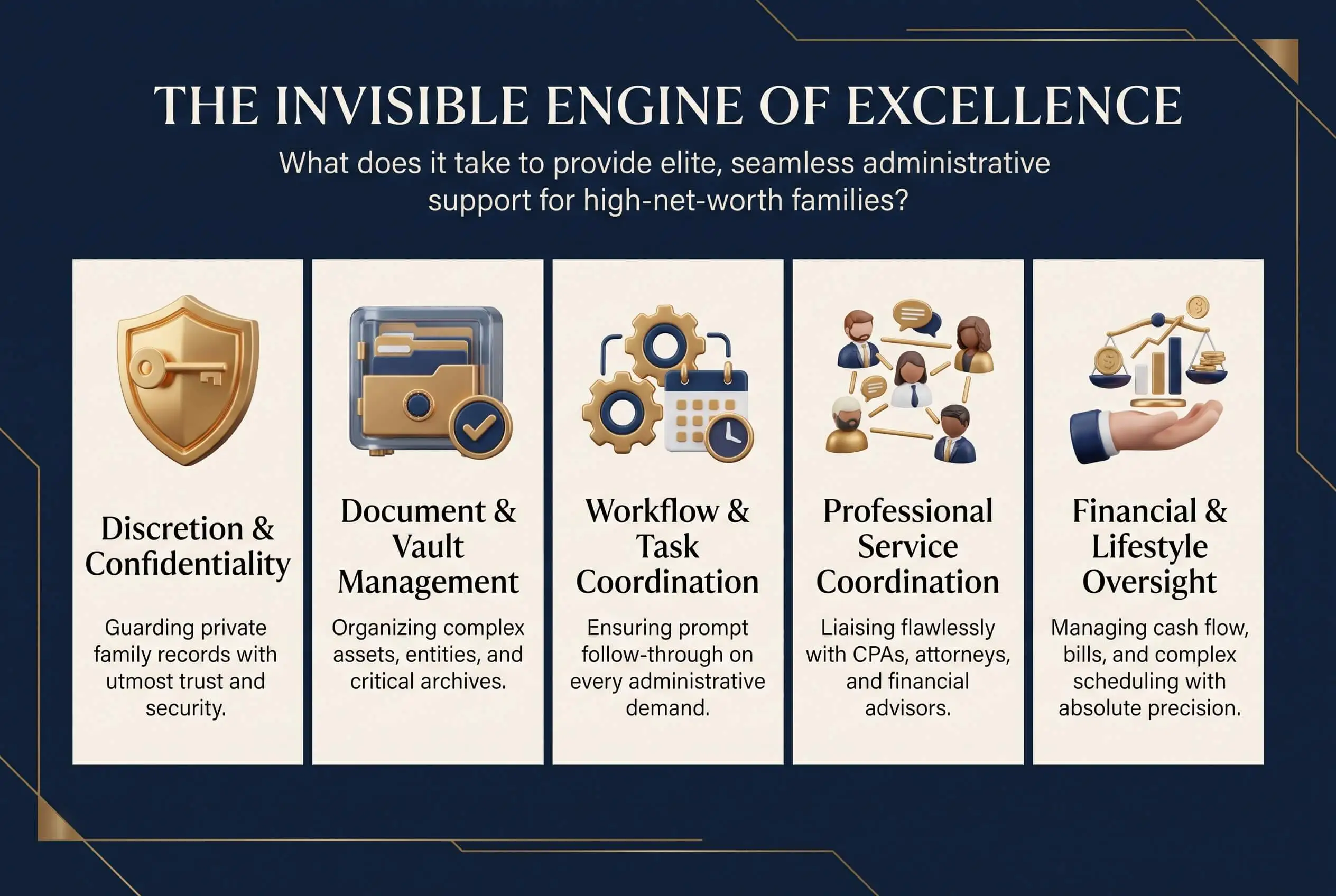
"Before we change anything for a new family, we inventory every account, entity, document, and advisor. We see the same pattern almost every time. A capable assistant has been carrying the whole system in their head, and that person is usually excellent. The risk is that everything depends on them. A renewal slips. A trust document turns up in three versions. The CPA waits on a K-1 nobody knew was missing. Skill matters, and so does structure. Structure keeps a family's records secure and its providers accountable when life gets complicated. We see the best results when a trusted assistant works inside a disciplined system."
7 Essential Resources
Every resource below is free to read. We chose government agencies and independent research over vendor blogs, so the guidance holds up when you write a job description or build a security checklist.
Wikipedia: Secretary. A plain-language history of the secretary role and how it grew into today's administrative and executive assistant positions.
BLS Occupational Outlook Handbook: Secretaries and Administrative Assistants. Federal data on the profession's duties, pay, training, and outlook.
O*NET OnLine: Executive Secretaries and Executive Administrative Assistants. This profile breaks down the tasks, skills, software, and work styles employers expect from senior assistants. We find it a useful starting point for a job description.
IAAP Certification. The International Association of Administrative Professionals explains its Certified Administrative Professional (CAP) credential, a common benchmark for experienced admins.
IRS: How Long Should I Keep Records? The IRS ties each retention period to the type of record. An assistant can build the family's retention schedule straight from this page.
CISA: More Than a Password. The Cybersecurity and Infrastructure Security Agency's guide to multifactor authentication. Anyone who touches a family's accounts should treat it as baseline reading.
Deloitte Private: The Family Office Cybersecurity Report, 2024. Survey data on how often family offices face cyberattacks and what they do to protect themselves.
3 Statistics
In 2024, secretaries and administrative assistants held about 3.5 million U.S. jobs, including roughly 502,800 executive secretaries and executive administrative assistants (BLS). The field is large. Only a small share of those professionals have worked inside a family office.
Executive secretaries and executive administrative assistants earned a median annual wage of $76,590 in 2025, based on Bureau of Labor Statistics data (O*NET OnLine). Family office roles that combine executive support with personal and household administration often pay well above that figure.
Deloitte Private found that 43% of family offices worldwide had a cyberattack in the previous 12 to 24 months, and the figure rose to 57% in North America (Deloitte Private). Security habits now belong on the administrative skills list. IT can't carry that load alone.
Read side by side, these numbers make one point. A family office can't pull from the general admin pool and hope for the best. The seat calls for senior experience, competitive pay, and real security discipline, with a system behind it that protects the family's records and supports personalised family office concierge services.
Final Thoughts and Opinion
Most families open this search with a stack of resumes. We'd start with trust. An interview can test skills, but discretion and judgment show themselves over years, in moments nobody else sees.
When administration breaks down, we usually find the family hired someone good and then ask that person to hold everything alone. Records lived in one inbox. Advisor requests lived in one memory. When the assistant took a vacation, moved on, or simply ran out of hours, every gap surfaced in the same week.
Families who do well pair a skilled assistant with structure. Documents sit in a secure vault with defined permissions, and advisors work from shared context. Recurring deadlines run on a repeatable workflow instead of a sticky note on someone's monitor. Good family office administrative support provides exactly that: a structured system that keeps a family's financial life organized and executed. It makes a great assistant even better.
So hire for the seven skills and check references with care. Then give that person a system worth working in.
Frequently Asked Questions
What does a family office administrative assistant do day to day?
Day to day, the assistant manages calendars, travel, correspondence, records, bills, and renewals for a principal and family. They also coordinate with outside advisors such as CPAs, estate attorneys, and insurance agents, gathering documents and tracking open items. The job blends business administration with personal and household support.
How is a family office assistant different from a corporate executive assistant?
A corporate executive assistant supports one executive inside a company. A family office assistant supports an entire family, often across generations, homes, and legal entities. Because they handle trusts, tax returns, and property records, the stakes for discretion and security run higher.
What qualifications should a family office administrative assistant have?
Most family offices look for several years of senior administrative or executive support experience, strong references, and fluency in Microsoft 365 or Google Workspace. Prior family office or high-net-worth experience helps. A credential such as the IAAP Certified Administrative Professional (CAP) shows a real commitment to the field.
How much does a family office administrative assistant earn?
Pay depends on location, experience, and scope. As a reference point, executive secretaries and executive administrative assistants earned a national median of $76,590 in 2025. Senior family office roles that add personal and household administration often pay more, especially in high-cost metro areas.
Can a family outsource family office administrative support instead of hiring?
Yes. Many families pair one in-house assistant with an outside team, and some rely on the outside team entirely. Outsourced family office administrative support can cover document management, secure electronic vaulting, provider coordination, and repeatable workflows without adding staff. It works alongside your CPA and attorney and never replaces them.
How do family office assistants protect confidential information?
A careful assistant shares information only with people who need it and sends sensitive files through secure portals instead of email attachments. They turn on multifactor authentication for every account. Before acting on an unusual payment or document request, they call to confirm it, because phishing is the most common attack family offices face.
Ready to Bring Structure to Your Family's Administration?
Start with an inventory. Write down every account, entity, property, advisor, and recurring deadline your family manages today. Then ask two questions. What can one skilled assistant reasonably carry? What needs a system behind it?
Your answers will show whether to hire, add outside support through professional family office services, or do both. Whichever path you take, you're working toward less admin and fewer loose ends, with a system that stays proactive, organized, and reliable.
Are you hiring a family office assistant now, or rethinking how your family's administration runs? Leave your questions in the comments and we'll answer them.