Month three is usually when an owner finds out. The bank reconciliation won't tie out, and last month's financials still haven't shown up. Nobody from the sales call answers email anymore.
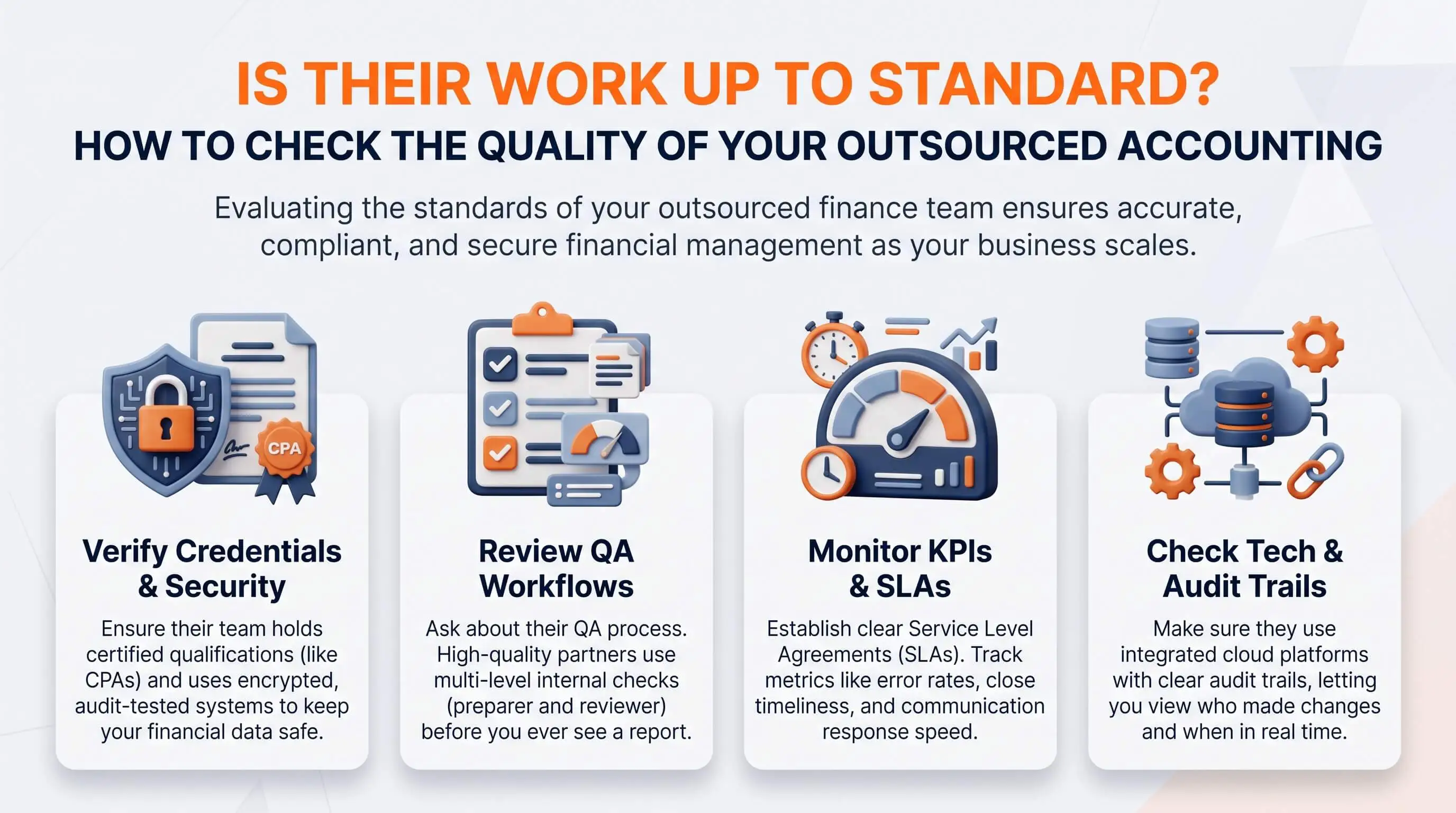
You can catch that before you sign. Check five things, in this order: who does the work, how they catch errors, how they protect your data, when your numbers arrive, and whether clients like you will vouch for them. If a firm answers all five with documents, it has earned a trial.
Order matters because a polished proposal can hide a rotating cast of junior staff or a review process that lives mostly on paper. By the time you notice, every hiring, pricing, and cash decision you make is running on the numbers that the firm sends back.
We've watched owners come to us after the wrong hire, and the story rarely changes. The best outsourced business and financial accounting firms are glad to show you how they work before you sign. The ones that struggle stay vague until the first invoice, so hold every firm to the questions below.
TL;DR Quick Answers
Best Outsourced Business and Financial Accounting Firms
The best outsourced business and financial accounting firms prove their quality with documents before you sign. Look for a firm that shows you all five of these:
People: a named team, with a CPA or enrolled agent reviewing the work
Process: a month-end close checklist and sample reconciliations they'll share on request
Security: a SOC 2 report or written data controls
Reporting: a close deadline written into the service agreement
Proof: references from clients in your industry and size range
Then match the service tier to your stage. Bookkeeping fits early-stage businesses, outsourced accounting fits growing teams without in-house finance staff, and a fractional CFO fits when growth or funding decisions are on the table. Shortlist two or three firms that clear every check, and run a 60-day trial before you commit to a long contract.
Top Takeaways
Quality in accounting means accurate, timely, secure books you can make decisions with.
Check people first, including who reviews the work and what credentials they hold.
Ask for a redacted close checklist and reconciliation before you sign anything.
Get close deadlines, report contents, and response times written into the agreement.
Verify credentials yourself through CPAverify and the IRS, then call two or three references.
Run a 60-day trial before you commit to a long contract.
What Does Quality Mean in an Outsourced Accounting Firm?
Quality means books you can run the business on. Accuracy only gets you halfway there, because numbers that arrive six weeks after month-end won't help you plan payroll or price a new contract, however clean they are.
Know what you're buying, too. Bookkeeping records transactions, and accounting reviews, reconciles, and reports on them. A fractional CFO takes those results and plans ahead with you. If the line between the first two still feels blurry, this look at full-service bookkeeping from transactions to reporting is a good place to start.
The Five Things to Check First
Go in order. If a firm stumbles on the first two, you can save yourself the rest of the meeting.
1. Who Actually Does the Work
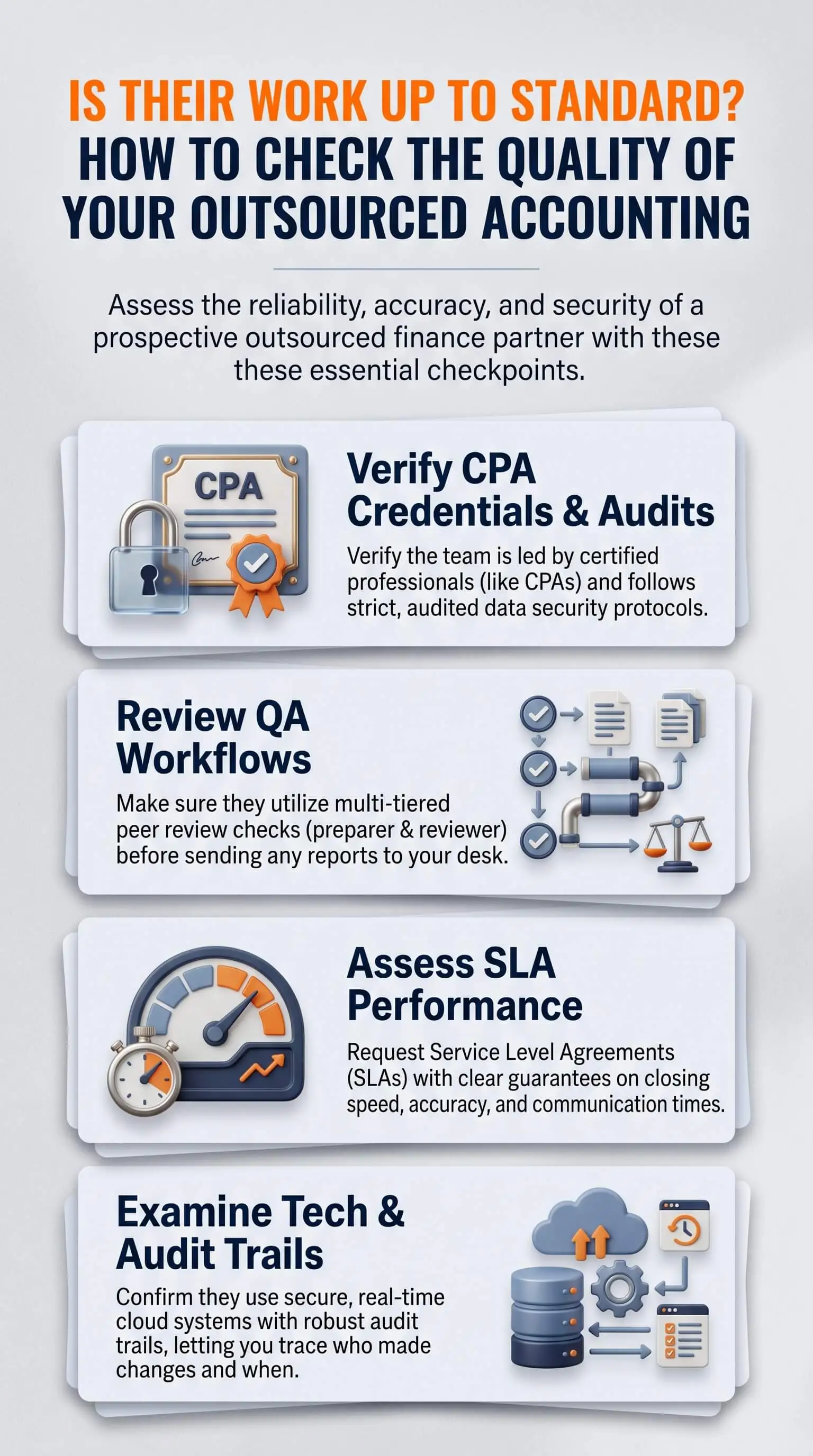
Ask who handles your account day to day and who reviews their work. You want names, roles, and credentials, ideally a CPA or an IRS enrolled agent in the review seat. Then ask how long that team has worked together. High turnover means re-explaining your business to someone new every few months.
2. How They Catch Errors Before You Do
Ask for a redacted month-end close checklist and a sample reconciliation. A firm with a real process pulls those up in minutes. A weaker one describes the process and hopes you won't ask twice. Listen for a second-person review on every close, not occasional spot checks.
3. How They Protect Your Financial Data
Your firm will hold your bank, payroll, and tax records. Ask where that data lives, who can reach it, and whether the firm has a SOC 2 report. No report? Then ask for its security controls in writing. While you're there, find out which accounting software they use and how it connects with your payroll, banking, and billing tools.
4. When and How You Get Your Numbers
Get the close deadline in writing, for example financials by the 10th business day. Ask what the monthly report includes, how often you'll meet, and how quickly they answer questions. Those commitments belong in the service agreement, because a promise made on a sales call won't help you in month six.
5. Proof From Clients Like You
Ask for two or three references in your industry and size range. On each call, ask how accurate the first three months were, what happened when something went wrong, and whether they'd hire the firm again. Then read the firm's case studies and look for specifics, since adjectives prove nothing.
Red Flags That Signal a Low-Quality Firm
Vague answers about who reviews the work
No written service levels or close deadlines
A pitch that leans almost entirely on price
A new contact every time you call
Nothing to show when you ask for sample reports or close documents
Pressure to sign a long contract before any trial
How the Best Outsourced Business and Financial Accounting Firms Compare
The right level of service depends on where your business is right now, and quality looks a little different at each tier.
Bookkeeping: Your firm records transactions, categorizes expenses, and reconciles bank accounts. Good work shows up as clean, reconciled books every month with few corrections. Early-stage and small businesses usually start here.
Outsourced accounting: Your firm runs the month-end close, books accruals, prepares financial statements, and reviews them. Good work means an on-time close, reviewed statements, and clear notes on anything that moved. Growing businesses and nonprofits without a finance team get the most from this tier.
Fractional CFO: Your firm handles forecasting, budgeting, cash planning, and board reporting. Good work looks like forward-looking guidance tied to your goals. It fits businesses facing growth, a funding round, or a major decision.
Run every firm you talk to through this scorecard so the conversations stay comparable.
People: Ask who works on your account and who reviews it. A strong firm names the team, their credentials, and the reviewer.
Process: Ask to see a close checklist and a reconciliation. A strong firm shares real, redacted documents when you ask.
Security: Ask how the firm protects your data. A strong firm hands over a SOC 2 report or its written controls and access policy.
Reporting: Ask when you'll get your financials. A strong firm commits to a written deadline and shows you a sample report.
Proof: Ask to speak with similar clients. A strong firm connects you with two or three references in your industry.
Run a 60-Day Trial Before You Commit
A sales call shows you how a firm sells, so give it a trial to see how it actually works. Start with one or two month-end closes or a defined cleanup project. Then measure accuracy, turnaround, and how fast the team answers your questions against what the firm promised.
Why Accounting Quality Is a Leadership Decision
Leaders act on the numbers in front of them. Every hire, price change, and expansion plan rests on the books behind it, which is why choosing a firm deserves the same care you'd give a senior hire. For more on how clear financials sharpen those calls, see how professional accounting services help leaders make smarter decisions.
"Most of the owners we meet didn't pick a bad firm on purpose. They picked on price and a good first call, and nobody asked to see a close checklist. Around month three, a reconciliation doesn't tie out or the reports stop showing up on time. The most revealing request we know is a simple one. Ask the firm to walk you through last month's close for a client like you, with the names blacked out. A firm with a real process will pull it up in minutes, and if they need a week to 'put something together,' you've learned what you needed to know. We also tell owners to judge the second meeting. The first one is sales. The second is where you meet the people who'll actually do your books."
7 Essential Resources
Every source here is free and official, so you can check what a firm tells you instead of taking its word for it.
NASBA CPAverify: State boards of accountancy feed this national database of CPA licenses. Look up the CPAs named on your account to confirm they're actively licensed and to see any disciplinary history.
IRS: Verify the Status of an Enrolled Agent: Shows how to confirm with the IRS Office of Enrollment that someone holds enrolled agent status.
IRS Enrolled Agent Program: Covers what the enrolled agent credential requires and how practitioners keep it current, which helps when a firm lists EAs on its team.
AICPA: 2017 Trust Services Criteria (Revised Points of Focus, 2022): The AICPA's official criteria behind SOC 2 reports, covering security, availability, processing integrity, confidentiality, and privacy. Skim it before you ask a firm about its controls.
System and Organization Controls (Wikipedia): A plain-language rundown of SOC 1, SOC 2, and SOC 3 reports and who can perform them.
BLS Occupational Outlook Handbook: Accountants and Auditors: Federal data on what accountants do, the education they usually need, and where the job market is headed.
IBM Cost of a Data Breach Report 2026: IBM's annual research on what breaches cost organizations, and a good reminder of why data security sits on your checklist.
3 Statistics Worth Knowing
The U.S. Bureau of Labor Statistics projects 5% employment growth for accountants and auditors from 2025 to 2035, with about 115,300 openings each year, many of them replacing people who retire or change careers (U.S. Bureau of Labor Statistics). Good accountants have options and move around, so ask any firm how it keeps its team together.
U.S. schools awarded 55,152 bachelor's and master's degrees in accounting in the 2023–24 academic year, 6.6% fewer than the year before (AICPA 2025 Trends Report). With fewer qualified people entering the field, confirm who will do your work and not only who signs the proposal.
IBM puts the global average cost of a data breach at $4.99 million in 2026, up 12% over the prior year and a record high (IBM Cost of a Data Breach Report 2026). Your accounting firm holds your bank, payroll, and tax records, which puts its security controls squarely on your quality checklist.
Final Thoughts and Opinion
We think price is the wrong place to start. The cheapest firm often ends up costing the most once you add the cleanup work and the decisions made on numbers nobody reviewed.
We've watched owners go from stressed and reactive about their books to structured and confident. New software almost never made the difference. A team that owned the account did, along with a close process the owner could see for themselves.
So take your time with the checklist, and don't skip the reference calls. Then give your top choice a short trial and judge it by what lands in your inbox each month.
Frequently Asked Questions
What credentials should an outsourced accounting firm have?
Look for CPAs or IRS enrolled agents in the review and advisory seats, with experienced bookkeepers handling the daily work. The reviewer's credentials matter most. You can confirm a CPA license through NASBA's CPAverify and enrolled agent status through the IRS Office of Enrollment.
How much does outsourced accounting cost?
Your price depends on transaction volume, the number of accounts, and whether you need bookkeeping, full accounting, or CFO-level support. Many firms charge a monthly package rather than an hourly rate. Compare what each package includes, like close deadlines and reporting, before you compare the fee.
Is outsourced accounting as reliable as an in-house team?
It can be more reliable when the firm runs a documented close process with a second-person review every month. An in-house hire is one person. A good firm brings a team with checks built in, and since reliability comes from process, ask to see it.
What is a SOC 2 report, and do I need my firm to have one?
In a SOC 2 report, an independent CPA examines a service provider's controls over security, availability, processing integrity, confidentiality, and privacy. Plenty of smaller firms don't have one. If yours doesn't, ask for its security controls and access policies in writing.
How long does it take to switch accounting firms?
Plan on one to two month-end closes, depending on how clean your current books are. A good firm maps out onboarding, requests access in a set order, and flags any cleanup work before your first close. Time the switch for month-end, not the middle of the month.
Ready to Find a Firm You Can Trust?
Start with the five checks. Pick two or three firms offering outsourced accounting and bookkeeping services near me, send each one the same scorecard questions, and book intro calls with the ones that answer with documents. A firm worth hiring will welcome the scrutiny, since checking the work is its whole job.
Vetted a firm recently, or have a question we didn't cover? Leave it in the comments, and we'll answer.