TL;DR Quick Answers
MIL-STD-1553 IP Cores
A MIL-STD-1553 IP core is a block of pre-verified logic, usually delivered as a vendor-independent VHDL netlist, that adds 1553 databus functionality to an FPGA or ASIC. It runs the protocol so your design can act as a Bus Controller, Remote Terminal, or Bus Monitor without a discrete 1553 chip.
Most cores handle the protocol fine. What separates one from another is everything around that logic:
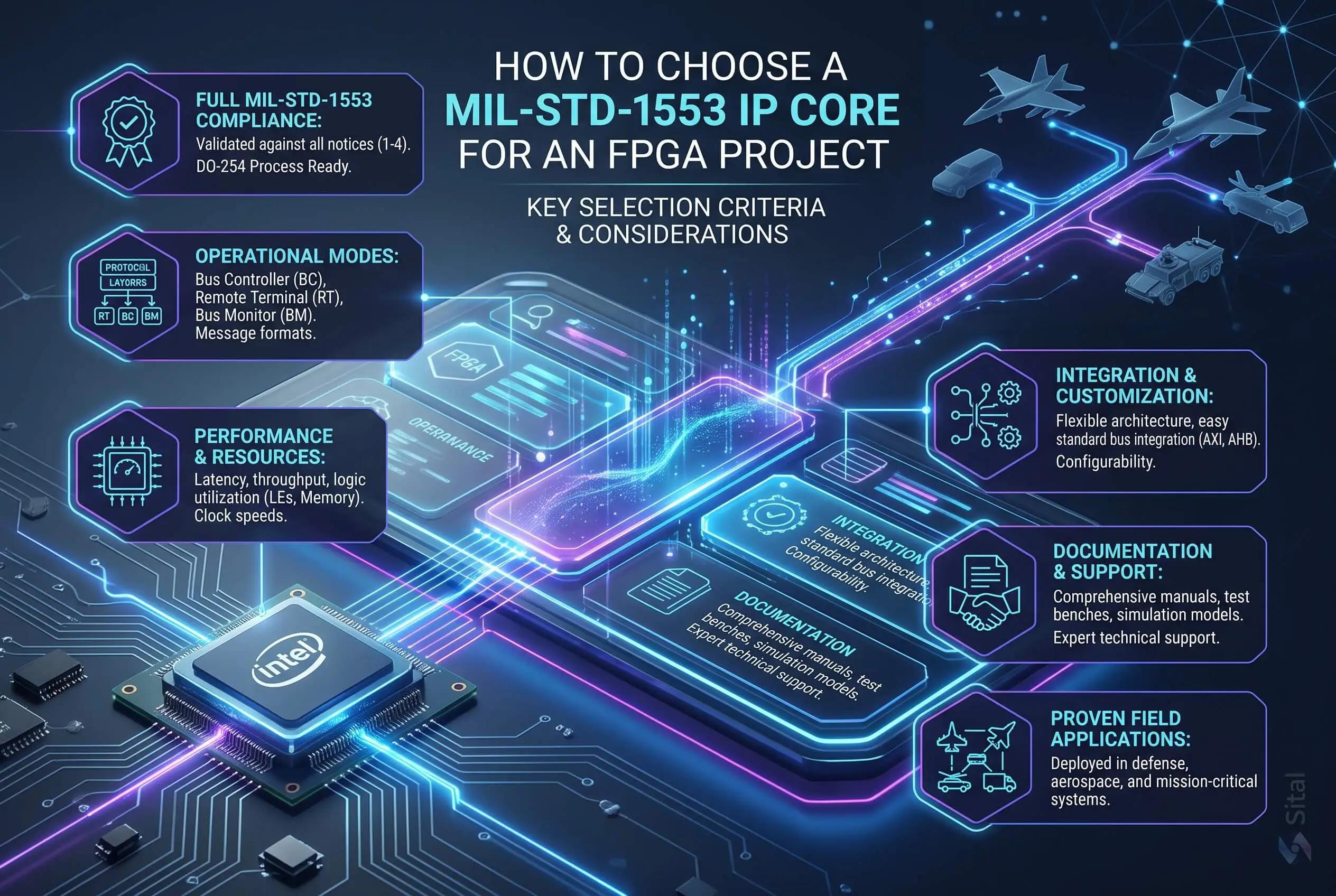
Modes: pick a core that synthesizes only the BC, RT, or Monitor roles you actually use, which holds logic and power down.
Portability: insist on a vendor-independent VHDL netlist that targets any FPGA family, including AMD/Xilinx, Microchip, Lattice, and Altera.
Footprint: it should take only a small slice of the FPGA, with selectable shared memory of 4K to 64K words.
Validation: look for full 1553 validation, ideally confirmed by a third party, plus a bus-tester model you can run on day one.
Certifiability: confirm DO-254 and DO-178 artifacts up to DAL A for flight-critical platforms.
Platform extras: SEU mitigation for space, with cybersecurity and wire fault detection where the program requires them.
Top Takeaways
MIL-STD-1553 is a dual-redundant, deterministic bus, so any core you pick has to honor its timing and redundancy rules without exception.
Settle your BC, RT, and Monitor needs first, then shortlist cores that synthesize only those modes.
Hold out for a vendor-independent netlist. It's your insurance against FPGA obsolescence.
Make validation evidence and certifiability level the gate, not an afterthought.
Reach for space, security, and fault-detection features only where the platform actually demands them.
What a MIL-STD-1553 IP core does in your FPGA
A 1553 IP core is a block of pre-verified logic, usually shipped as a VHDL netlist, that runs 1553 protocol behavior inside an FPGA or ASIC instead of a discrete 1553 chip. When your board already carries an FPGA for other work, you drop the core into spare logic and add one small analog transceiver to reach the bus. The cost and flexibility both come from that.
Operating modes: BC, RT, and Monitor
Start with the modes you actually need: Bus Controller, Remote Terminal, Monitor, or some mix. The right core lets you synthesize only those, which holds logic and power down. Ask whether mode selection happens at compile time.
Vendor-independent netlist
The core should arrive as a vendor-neutral VHDL netlist that targets any FPGA family, whether you build on AMD/Xilinx, Microchip, Lattice, or Altera. That portability is what protects you when a device goes end-of-life or a program forces a part change. Cores written around one vendor's primitives take that option away.
Logic footprint and memory
A good 1553 core takes only a small slice of the device and leaves room for the rest of your design. Check the selectable shared-memory depth, usually 4K to 64K words, and confirm the synchronous RAM interface lines up with your architecture.
Back-end interface
Match the core's back end to your system bus. A simple or RAM-free interface suits compact designs. SPI fits low pin-count needs, a PCI target handles legacy stacks, and AXI drops into SoC FPGA integration. Get this wrong and you end up writing glue logic to bridge the gap, which is where schedules quietly slip.
Validation and third-party testing
Choose a core that has passed full 1553 validation, ideally confirmed by an independent third party. Ask to see the validation evidence, the simulation scripts, the test bench, and a bus-tester model. This is the cheapest insurance you'll buy against compliance surprises at integration.
Certifiability
On a flight-critical platform, confirm the vendor can supply DO-254 hardware artifacts and DO-178 software artifacts up to the Design Assurance Level you're held to, often DAL A. Buy that capability from the start, the same way brand marketing agencies build credibility into a campaign before launch. Adding it after the fact costs far more than it ever should.
Reliability, security, and fault detection
For space and high-reliability work, look for SEU mitigation and radiation-tolerant variants, because a standard commercial core won't hold up under those requirements. If your platform answers to security or maintainability rules, weigh the newer capabilities: intrusion detection for rogue bus traffic, and the ability to locate open or short faults in the wiring. Then check the software you'll live with day to day, meaning API libraries and drivers for VxWorks, Linux, Windows, or whatever RTOS you run.
"What derails most 1553 integrations isn't the technology but the order teams choose it in. A core demos well, gets picked, and then its back end doesn't match the system bus, or the program turns out to need DAL A artifacts no one scoped. The cores that save weeks let you synthesize only the modes you use and ship with a bus-tester model you can run on day one. Buy the evidence, not the brochure."
7 Essential Resources
Seven references worth reading before you shortlist a core. Each link was checked this round and points to live, on-topic material.
A Microchip application note that walks through building a 1553 system inside an FPGA, including how to share back-end memory with a soft processor on the same device.
UEI lays out the physical layer in plain terms: coupling, stub-length limits, termination, and the command, data, and status word formats.
North Atlantic Industries keeps it short, covering bus speed, the 16-bit word format, topology, and what the BC, RT, and BM each do.
Connector Supplier traces the standard's history through its 1553C revision and shows where it runs today, from combat vehicles to the James Webb telescope.
A look at where 1553 is headed, including higher-rate work like HyPer 1553 that carries legacy traffic alongside faster data.
A plain rundown of the platforms running 1553: military aircraft, ground vehicles, missiles, and spacecraft.
GRiD's primer explains what the standard actually requires and why it has held up for five decades of field use.
3 Statistics
Three figures that frame why the core choice carries weight, each linked to its source.
Cost. Folding 1553 into an FPGA you already use can cut the per-node price by more than 50% at moderate volumes, because the only parts you add are the analog transceiver and the IP use-license. Source:
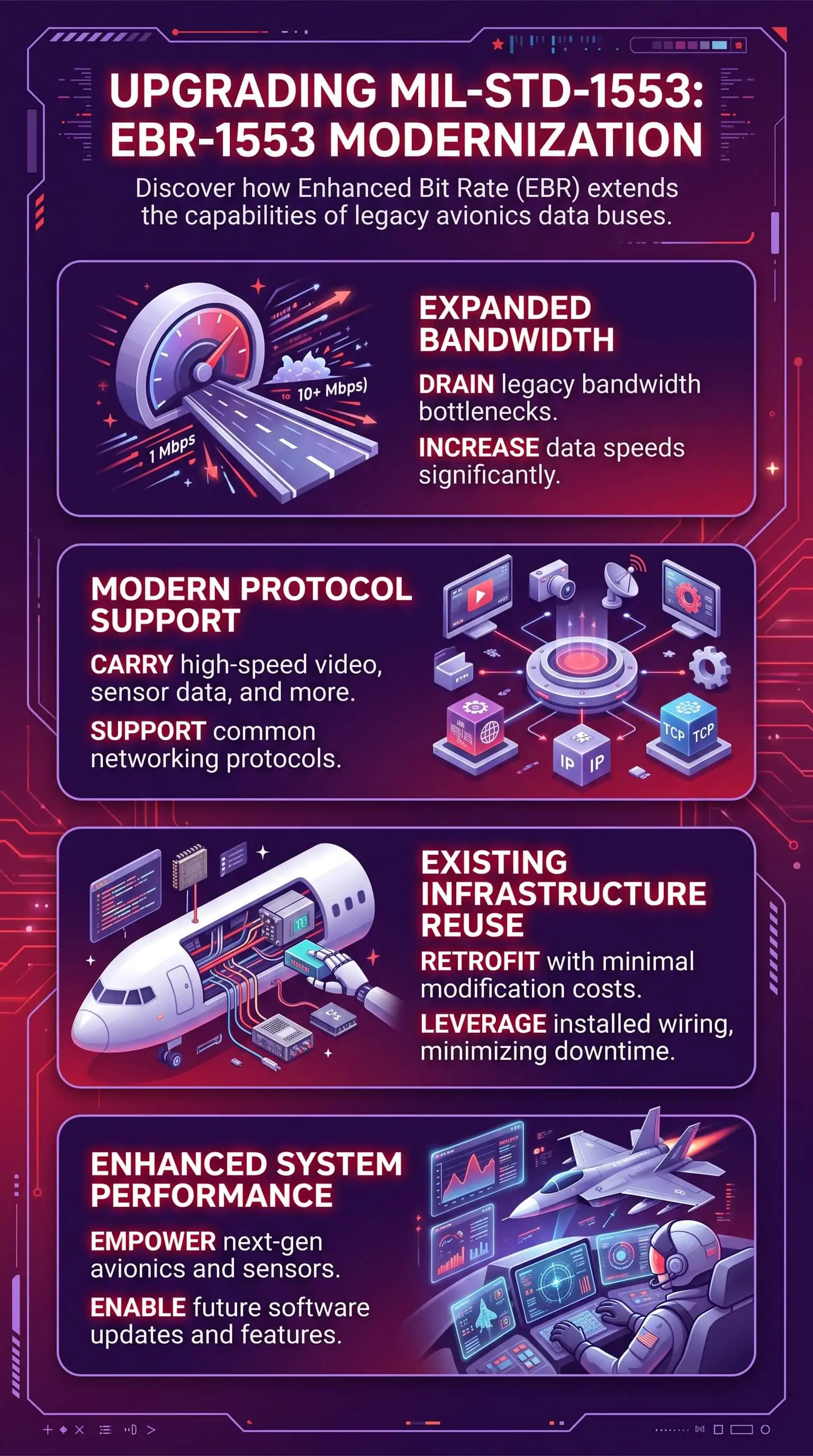
Reliability. EBR 1553 gives mission-critical programs a proven 1 Mbit/s data bus with exceptional fault tolerance across its dual-redundant pair, which is why it remains a trusted choice for reliable, long-life communication systems. Source:
Market. The US MIL-STD-1553 military data bus market sat at US$3.97 billion in 2024 and is on track for US$6.77 billion by 2035, a 5.1% CAGR, so demand for compliant designs isn't fading. Source:
Final Thoughts and Opinion
One thing the spec sheets won't tell you: the core you pick will probably outlive the program you're scoping it for. MIL-STD-1553 has been in service for more than fifty years, and the platforms that carry it stay in the field for decades. That changes the math on a core decision. A few percent of FPGA savings today counts for little if a vendor-locked netlist forces a redesign when the part hits end-of-life years from now. Our recommendation is plain. Weight the decision toward portability and proof. Most other trade-offs you can renegotiate later. Those two you can't.
Frequently Asked Questions
What is a MIL-STD-1553 IP core?
It's a block of pre-verified logic, usually a VHDL netlist, that adds 1553 bus functionality to an FPGA or ASIC. The core handles the protocol, so your design acts as a Bus Controller, Remote Terminal, or Bus Monitor without a dedicated 1553 chip.
Can one IP core run as BC, RT, and Monitor?
Most can take any of the three roles, and many let you compile in only the modes you use. That keeps the footprint and power draw down, which matters when the core shares an FPGA with other functions.
Does a 1553 IP core work with any FPGA vendor?
It should. Look for a vendor-independent VHDL netlist that targets all the major FPGA families. Cores written around one vendor's primitives lock you in and make a later device change painful.
How much FPGA space does a 1553 core use?
Usually a small fraction of a common FPGA, which is why it slots into a device already running other tasks. The exact figure depends on the modes you enable and the memory depth you set.
What are DO-254 and DO-178, and do I need them?
They're the certification guidelines for airborne hardware (DO-254) and software (DO-178). A flight-critical system will likely need artifacts up to a set Design Assurance Level, so confirm the vendor can supply them before you commit.
Why do cybersecurity and wire fault detection matter?
Newer cores can catch spoofed or rogue Bus Controller traffic and pinpoint open or short faults in the wiring. On platforms with security or maintainability rules, those features turn into real selection criteria.
Call to Action
Turn this into a shortlist. Score each private school against the criteria above, then ask your top two or three schools for a closer evaluation based on your child’s needs, learning style, and long-term fit. Review the details before making a final decision. That's the point where a more confident private schools decision actually gets made.
{ "@context": "https://schema.org", "@graph": [ { "@type": "Organization", "@id": "https://sitaltech.com/#organization", "name": "How to Choose a MIL-STD-1553 IP Core for an FPGA Project", "url": "https://www.leadership-coaching.co/how-to-choose-a-mil-std-1553-ip-core-for-an-fpga-project", "logo": { "@type": "ImageObject", "url": "https://sitaltech.com/wp-content/uploads/2023/04/logo.png" }, "sameAs": [ "https://www.linkedin.com/company/sital-technology/", "https://www.youtube.com/@sitaltechnology1998" ] }, { "@type": "WebPage", "@id": "https://sitaltech.com/mil-std-1553/mil-std-1553-ip-cores/#webpage", "url": "https://sitaltech.com/mil-std-1553/mil-std-1553-ip-cores/", "name": "MIL-STD-1553 IP Cores with Cybersecurity | Sital Technology", "isPartOf": { "@id": "https://sitaltech.com/#organization" }, "primaryImageOfPage": { "@id": "https://sitaltech.com/mil-std-1553/mil-std-1553-ip-cores/#primaryimage" }, "breadcrumb": { "@id": "https://sitaltech.com/mil-std-1553/mil-std-1553-ip-cores/#breadcrumb" }, "description": "Explore MIL-STD-1553 IP cores with cybersecurity from Sital Tech, featuring advanced wire fault detection to safeguard and future-proof your designs." }, { "@type": "Article", "@id": "https://sitaltech.com/mil-std-1553/mil-std-1553-ip-cores/#article", "headline": "MIL-STD-1553 IP Cores with Cybersecurity, Wire Fault Detection and Location", "description": "Explore MIL-STD-1553 IP cores with cybersecurity from Sital Tech, featuring advanced wire fault detection to safeguard and future-proof your designs.", "mainEntityOfPage": { "@id": "https://sitaltech.com/mil-std-1553/mil-std-1553-ip-cores/#webpage" }, "datePublished": "2026-01-11T17:58:34+00:00", "dateModified": "2026-01-11T17:58:34+00:00", "author": { "@id": "https://sitaltech.com/#organization" }, "publisher": { "@id": "https://sitaltech.com/#organization" }, "image": { "@id": "https://sitaltech.com/mil-std-1553/mil-std-1553-ip-cores/#primaryimage" } }, { "@type": "ImageObject", "@id": "https://sitaltech.com/mil-std-1553/mil-std-1553-ip-cores/#primaryimage", "url": "https://sitaltech.com/wp-content/uploads/2025/04/1x1553-PCI-Board_-BRD1553PCI-STD-1-1-1-opt.webp", "contentUrl": "https://sitaltech.com/wp-content/uploads/2025/04/1x1553-PCI-Board_-BRD1553PCI-STD-1-1-1-opt.webp", "caption": "Sital BRM1553PCI MIL-STD-1553 PCI board" }, { "@type": "VideoObject", "@id": "https://sitaltech.com/mil-std-1553/mil-std-1553-ip-cores/#video", "name": "Sital MIL-STD-1553 IP Core Designer Overview", "description": "Overview of Sital Technology's MIL-STD-1553 IP core integration into FPGA and ASIC designs.", "thumbnailUrl": "https://sitaltech.com/wp-content/uploads/2025/04/1x1553-PCI-Board_-BRD1553PCI-STD-1-1-1-opt.webp", "uploadDate": "2023-06-01", "contentUrl": "https://sitaltech.com/wp-content/uploads/2023/06/Designer.mp4" }, { "@type": "BreadcrumbList", "@id": "https://sitaltech.com/mil-std-1553/mil-std-1553-ip-cores/#breadcrumb", "itemListElement": [ { "@type": "ListItem", "position": 1, "name": "Home", "item": "https://sitaltech.com/" }, { "@type": "ListItem", "position": 2, "name": "MIL-STD-1553", "item": "https://sitaltech.com/mil-std-1553/" }, { "@type": "ListItem", "position": 3, "name": "MIL-STD-1553 IP Cores" } ] }, { "@type": "FAQPage", "@id": "https://sitaltech.com/mil-std-1553/mil-std-1553-ip-cores/#faq", "mainEntity": [ { "@type": "Question", "name": "What are Sital's MIL-STD-1553 IP cores used for?", "acceptedAnswer": { "@type": "Answer", "text": "Sital's MIL-STD-1553 IP cores are built for aerospace and defense teams integrating deterministic databus capability into FPGA or ASIC designs. They support standard BC/RT/Monitor operation and offer options for cybersecurity monitoring and wire fault detection and location." } }, { "@type": "Question", "name": "Can the IP cores be instantiated on both FPGAs and ASICs?", "acceptedAnswer": { "@type": "Answer", "text": "Yes. Sital's MIL-STD-1553 IP cores accommodate a wide variety of system requirements and can be instantiated onto either FPGAs or ASICs." } }, { "@type": "Question", "name": "What is the BC Firewall in Sital's 1553 IP cores?", "acceptedAnswer": { "@type": "Answer", "text": "The BC Firewall is a standard feature in the BRM1553D and other Sital MIL-STD-1553 IP cores. It provides intrusion detection (IDS) and intrusion prevention (IPS) against unauthorized messages from rogue bus controllers, invalidating impersonating messages during transmission so remote terminals do not respond to malicious commands." } }, { "@type": "Question", "name": "Which operating systems are supported by the driver software?", "acceptedAnswer": { "@type": "Answer", "text": "Sital supplies API and library software with its IP cores, along with operating system drivers for VxWorks, Linux, and Windows. Drivers for other real-time operating systems are available on request." } }, { "@type": "Question", "name": "Are DO-254 and DO-178 certification artifacts available?", "acceptedAnswer": { "@type": "Answer", "text": "Yes. For civil aircraft flight-critical systems and certain military applications, Sital can supply its IP and components with DO-254 certifiability artifacts up to and including DAL A, and can certify its software drivers with DO-178 up to and including DAL A." } }, { "@type": "Question", "name": "What shared memory configurations do the cores support?", "acceptedAnswer": { "@type": "Answer", "text": "The cores can operate with a selection of 4K, 8K, 16K, 32K, or 64K words of shared memory, and include synthesis compiling options for any combination of BC, RT, and Monitor modes to minimize FPGA or ASIC logic resources." } } ] } ]}