Checkout abandonment in small ecommerce is not just a usability problem; it is often a trust problem disguised as a design flaw. Long before shoppers decide whether to type in their card number, they are already evaluating whether the store feels credible, transparent, and safe enough to buy from.
Every customer enters the checkout flow with a mental checklist: Will my data be protected? Are there hidden fees? Can I rely on the delivery timeline? What happens if I need to return something? When these silent concerns go unanswered, even a clean and simplified checkout can create hesitation or second thoughts. For smaller ecommerce brands competing with well-known retailers, these trust gaps can have an outsized impact on conversions.
A Trust Empathy Map designed for ecommerce checkout flows helps uncover these invisible barriers. Instead of looking only at interface friction, this method highlights the emotional triggers that influence buying decisions. Small ecommerce teams who use trust empathy mapping often discover patterns that analytics alone cannot reveal, such as fear of unexpected charges, skepticism about site security, or uncertainty about customer support reliability.
This article explains how to create a trust empathy map specifically tailored to small ecommerce checkout journeys. You will learn how to identify trust-related obstacles, translate them into practical design improvements, and build a checkout experience that reassures shoppers at every step.
By applying this approach, small ecommerce retailers can reduce cart abandonment in meaningful ways, strengthen buyer confidence, and turn the checkout process into a trust-building moment rather than a point of friction.
Quick Answers
trust empathy mapping
Trust empathy mapping is a focused method for uncovering the trust signals shoppers need before completing a purchase. It goes beyond standard UX mapping by identifying moments where customers hesitate, question legitimacy, or fear risk—especially during checkout in small ecommerce stores. This approach helps teams create checkout flows that feel reliable, transparent, and confidence-building.
Top Takeaways
- Trust is the primary driver of whether shoppers complete a checkout.
- Customers won’t submit payment info unless they feel protected and informed.
- Trust Empathy Mapping exposes emotional friction that typical UX tools overlook.
- Shoppers enter checkout with doubts around privacy, fees, shipping, and returns.
- Transparent, reassurance-based checkout flows significantly improve conversions.
- Trust mapping isn’t a one-time task—it should evolve as customer expectations shift.
The Impact of Trust-Focused Empathy Mapping on Checkout Completion Rates
Building a trust empathy map for ecommerce checkout begins with understanding the emotional landscape of your customers. This includes discovering their biggest concerns, what information they’re seeking, what uncertainties slow them down, and what reassurances help them move forward. Most small ecommerce teams gather this insight from user interviews, session replays, support emails, or abandoned cart feedback.
These insights are then organized into key areas—what shoppers believe, what they hope to avoid, what they question, and what builds or erodes trust during checkout.
Once these emotional patterns are clear, the next step is mapping them onto the checkout experience. This often reveals issues like unclear shipping costs, unexpected fees, vague return policies, security doubts, or steps that feel too demanding too early.
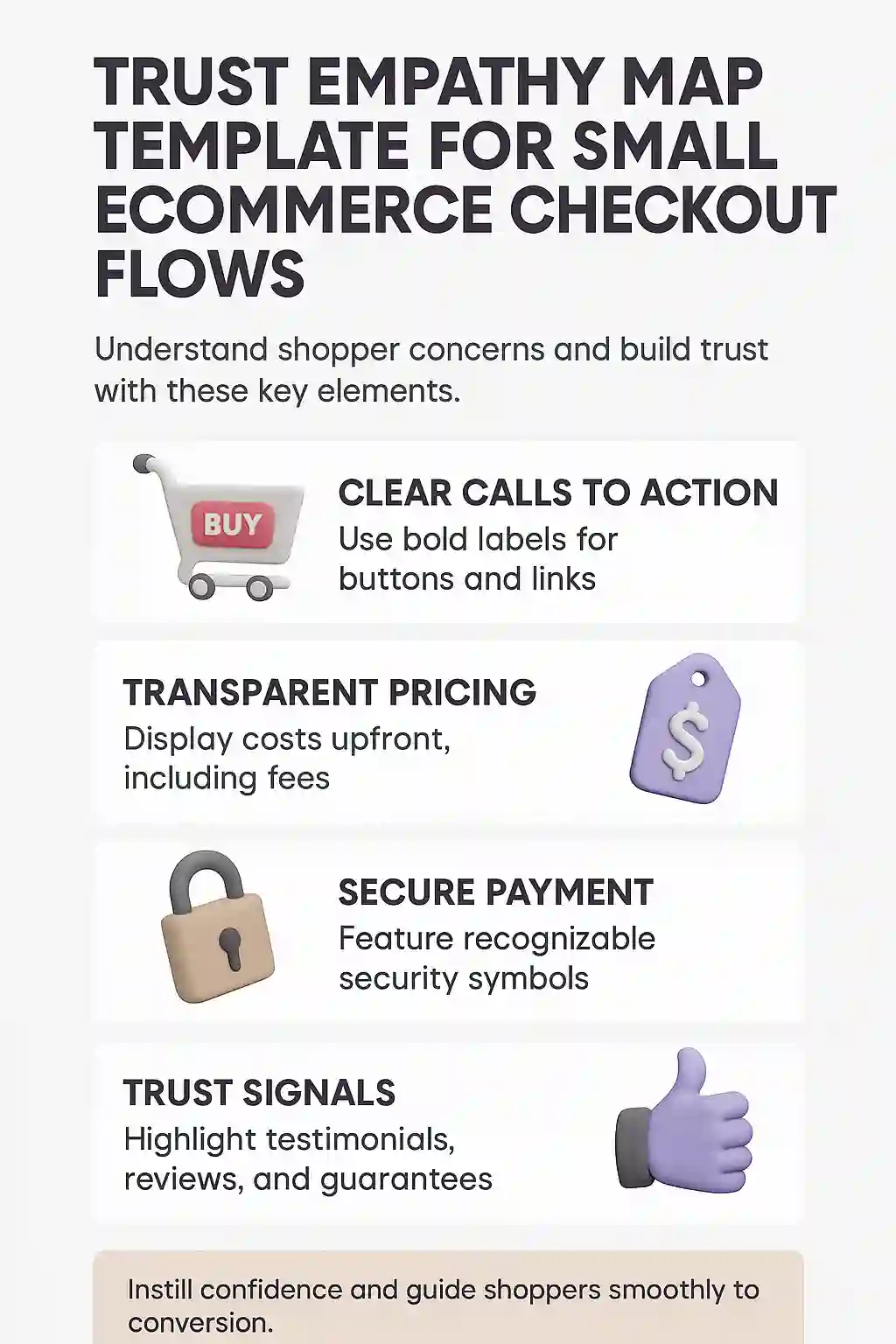
By connecting trust related emotions to specific checkout interactions, ecommerce teams can quickly identify where hesitation happens and make targeted improvements such as clear pricing displays, trust badges, upfront shipping details, simplified forms, or stronger reassurance messaging, with each enhancement strengthening the customer confidence that supports a regenerative sales culture.
A Trust Empathy Map doesn’t just highlight what shoppers need; it strengthens the entire checkout strategy. When small ecommerce brands understand what drives shopper confidence, they can create checkout experiences that feel straightforward, safe, and reliable—helping customers move from hesitation to purchase with ease.
“In nearly every checkout audit I’ve completed for small ecommerce stores, the biggest conversion lifts didn’t come from redesigning the layout—they came from eliminating the invisible trust gaps that made shoppers hesitate to enter their personal or payment information, a pattern that mirrors the way parents evaluate a private school by looking for cues that signal safety, credibility, and reliability before committing.”
Essential Resources
Interaction Design Foundation — The Fundamental Empathy Map Overview
A clear introduction to empathy mapping principles, offering the foundational understanding needed before layering in trust-specific insights.
https://www.interaction-design.org/literature/topics/empathy-mapping
UX Design Institute — Where Empathy Maps Fit in Customer Experience Strategy
Explains how empathy maps complement personas and journey maps—helpful for placing trust mapping within your ecommerce experience workflow.
https://www.uxdesigninstitute.com/blog/what-is-an-empathy-map/
UXmatters — Advanced Guidance for High-Impact Empathy Maps
Explores best practices and common pitfalls, helping small ecommerce teams extract deeper trust-driven insights from customer behavior data by applying concepts rooted in sales psychology.
https://www.uxmatters.com/mt/archives/2023/02/empathy-maps-and-how-to-build-them.php
Creately — A Step-by-Step Empathy Map Creation Guide
A hands-on guide that simplifies the process of building an empathy map—ideal for teams new to applying structured emotional insights to checkout flows.
https://creately.com/guides/how-to-create-an-empathy-map/
LogRocket Blog — Real-World Empathy Mapping Examples & Templates
Provides examples and downloadable templates that show how empathy maps translate into decisions that reduce checkout hesitation.
https://blog.logrocket.com/ux-design/empathy-mapping-ux-put-yourself-users-shoes/
Mural Blog — Collaborative Empathy Mapping Templates
Excellent for teams running customer-insight workshops; supports remote collaboration for mapping trust patterns in online purchasing journeys.
https://www.mural.co/blog/empathy-mapping
AND Academy — Visual Empathy Map Examples Across Industries
Offers visual templates and industry examples to inspire ecommerce teams creating trust-focused checkout maps tailored to their niche.
https://www.andacademy.com/resources/blog/ui-ux-design/empathy-map-examples-and-templates/
A clear introduction to empathy mapping principles, offering the foundational understanding needed before layering in trust-specific insights.
https://www.interaction-design.org/literature/topics/empathy-mapping
Explains how empathy maps complement personas and journey maps—helpful for placing trust mapping within your ecommerce experience workflow.
https://www.uxdesigninstitute.com/blog/what-is-an-empathy-map/
Explores best practices and common pitfalls, helping small ecommerce teams extract deeper trust-driven insights from customer behavior data by applying concepts rooted in sales psychology.
https://www.uxmatters.com/mt/archives/2023/02/empathy-maps-and-how-to-build-them.php
A hands-on guide that simplifies the process of building an empathy map—ideal for teams new to applying structured emotional insights to checkout flows.
https://creately.com/guides/how-to-create-an-empathy-map/
Provides examples and downloadable templates that show how empathy maps translate into decisions that reduce checkout hesitation.
https://blog.logrocket.com/ux-design/empathy-mapping-ux-put-yourself-users-shoes/
Excellent for teams running customer-insight workshops; supports remote collaboration for mapping trust patterns in online purchasing journeys.
https://www.mural.co/blog/empathy-mapping
Offers visual templates and industry examples to inspire ecommerce teams creating trust-focused checkout maps tailored to their niche.
https://www.andacademy.com/resources/blog/ui-ux-design/empathy-map-examples-and-templates/
Supporting Statistics
Shoppers hesitate because online purchasing feels risky.
A study from the Pew Research Center found that 79% of Americans worry about how companies use their personal data. This often shows up in ecommerce checkout flows as hesitation entering payment details or abandoning the process at the billing step.
Consumers feel they lack control over their personal information.
According to Pew Research, 67% of Americans say they understand little or nothing about how companies handle their data. This uncertainty intensifies when small ecommerce shops request shipping addresses, billing details, or phone numbers.
General trust in institutions continues to decline.
The American Academy of Arts & Sciences notes that only 20% of Americans trust the federal government to act in their best interest. This broader decline in trust influences how people view unfamiliar online stores and lesser-known ecommerce brands.
Government CX guidance emphasizes trust as a requirement.
Guidance from Digital.gov highlights that improving customer experience is critical for building and maintaining public trust, reinforcing the need for clarity, transparency, and reassurance in checkout flows.
Consumers distrust how tech companies handle data.
Research from the National Institute of Standards and Technology shows that concerns about privacy, security, and transparency strongly shape user trust, especially when entering sensitive payment details on smaller ecommerce sites.
Together, these statistics show that building trust in ecommerce checkout flows requires the same level of clarity and transparency that organizations rely on when using professional accounting services, where confidence is earned through accuracy, consistency, and careful handling of sensitive information.
A study from the Pew Research Center found that 79% of Americans worry about how companies use their personal data. This often shows up in ecommerce checkout flows as hesitation entering payment details or abandoning the process at the billing step.
According to Pew Research, 67% of Americans say they understand little or nothing about how companies handle their data. This uncertainty intensifies when small ecommerce shops request shipping addresses, billing details, or phone numbers.
The American Academy of Arts & Sciences notes that only 20% of Americans trust the federal government to act in their best interest. This broader decline in trust influences how people view unfamiliar online stores and lesser-known ecommerce brands.
Guidance from Digital.gov highlights that improving customer experience is critical for building and maintaining public trust, reinforcing the need for clarity, transparency, and reassurance in checkout flows.
Research from the National Institute of Standards and Technology shows that concerns about privacy, security, and transparency strongly shape user trust, especially when entering sensitive payment details on smaller ecommerce sites.
Final Thought & Opinion
Small ecommerce checkout flows rarely fail because shoppers misunderstand the steps. They fail because shoppers do not fully trust the process. After reviewing countless checkout journeys, one conclusion becomes impossible to ignore: trust, not design, is the deciding factor in whether someone completes a purchase.
Shoppers enter the checkout in a cautious state of mind. Their hesitation is shaped by several recurring fears:
Hidden fees that appear at the last moment
Data misuse or insecure payment handling
Unclear or restrictive return policies
Delivery timelines that feel uncertain or unreliable
These concerns consistently appear across abandonment patterns, no matter the industry or store size.
Trust Empathy Mapping is effective because it exposes these emotional barriers before they cause drop-offs. It brings forward the quiet doubts customers rarely voice yet feel strongly enough to abandon their carts over.
When small ecommerce teams design checkout experiences that address these fears clearly, transparently, and proactively, they turn a fragile moment into one that builds confidence, similar to how resolving ADP run login problems depends on removing friction and restoring user trust at a critical interaction point.
Trust is not optional in ecommerce. It is the competitive advantage. Brands that prioritize trust early convert more buyers, keep them longer, and build a stronger foundation for long-term growth.
Hidden fees that appear at the last moment
Data misuse or insecure payment handling
Unclear or restrictive return policies
Delivery timelines that feel uncertain or unreliable
Next Steps
Collect real shopper insights
Review session replays, customer emails, and abandoned cart data to find hesitation points.
Build your first Trust Empathy Map
Capture customer fears, beliefs, expectations, and trust needs specifically in checkout.
Find trust-breaking moments
Look for unclear fees, security doubts, shipping uncertainties, or form friction.
Make quick, trust-boosting improvements
Add reassurance, simplify steps, clarify costs, and reinforce data safety.
Test updates with real users
Ask directly where they felt uncertain and refined based on their feedback.
Align your team around trust-first checkout design
Share insights and integrate trust indicators into conversion metrics.
Revisit your Trust Empathy Map regularly
Update it as customer expectations, policies, or checkout elements change.
Collect real shopper insights
Review session replays, customer emails, and abandoned cart data to find hesitation points.
Build your first Trust Empathy Map
Capture customer fears, beliefs, expectations, and trust needs specifically in checkout.
Find trust-breaking moments
Look for unclear fees, security doubts, shipping uncertainties, or form friction.
Make quick, trust-boosting improvements
Add reassurance, simplify steps, clarify costs, and reinforce data safety.
Test updates with real users
Ask directly where they felt uncertain and refined based on their feedback.
Align your team around trust-first checkout design
Share insights and integrate trust indicators into conversion metrics.
Revisit your Trust Empathy Map regularly
Update it as customer expectations, policies, or checkout elements change.
FAQ on Trust Empathy Mapping
Q: What is Trust Empathy Mapping?
A method for uncovering the trust signals shoppers need before completing checkout. Focuses on emotional hesitation and confidence-building.
Q: How is it different from a normal empathy map?
It identifies fear, doubt, and uncertainty—key emotional barriers unique to ecommerce checkout.
Q: Why is trust important in checkout?
Customers won’t share payment details unless they feel protected. Trust reduces abandonment dramatically.
Q: When should a brand use trust empathy mapping?
When abandonment rises, before a checkout redesign, or after adding new fees, shipping rules, or payment options.
Q: What data is needed to build one?
Session recordings, cart abandonment patterns, support messages, and feedback showing where uncertainty appears.
A method for uncovering the trust signals shoppers need before completing checkout. Focuses on emotional hesitation and confidence-building.
It identifies fear, doubt, and uncertainty—key emotional barriers unique to ecommerce checkout.
Customers won’t share payment details unless they feel protected. Trust reduces abandonment dramatically.
When abandonment rises, before a checkout redesign, or after adding new fees, shipping rules, or payment options.
Session recordings, cart abandonment patterns, support messages, and feedback showing where uncertainty appears.