This guide breaks down the brain training exercises proven to enhance memory, explaining why they work, how to practice them daily, and how to avoid common mistakes that limit progress. Built on real-world testing and cognitive science, this approach goes beyond generic advice to deliver measurable results.
Quick Answers
brain training exercises
Brain training exercises are targeted mental activities designed to improve memory, focus, and cognitive flexibility. They work best when they involve active recall, problem-solving, and real-world application rather than passive repetition. Short, consistent practice produces the strongest results.
Top Takeaways
Brain training works when it reflects real-life memory use.
Short, consistent practice outperforms long, infrequent sessions.
Targeted exercises matter more than variety or speed.
Research-backed methods deliver better results than gimmicks.
Small daily habits lead to measurable memory improvement.
How Brain Training Activities Improve Memory
Memory improves when the brain is challenged to encode, store, and retrieve information more efficiently. The most effective brain training activities strengthen neural connections involved in attention, recall, and pattern recognition—rather than relying on passive repetition. At InfiniteMind, testing shows that activities combining mental effort, novelty, and recall deliver the strongest memory gains.
The Most Effective Memory-Boosting Brain Training Activities
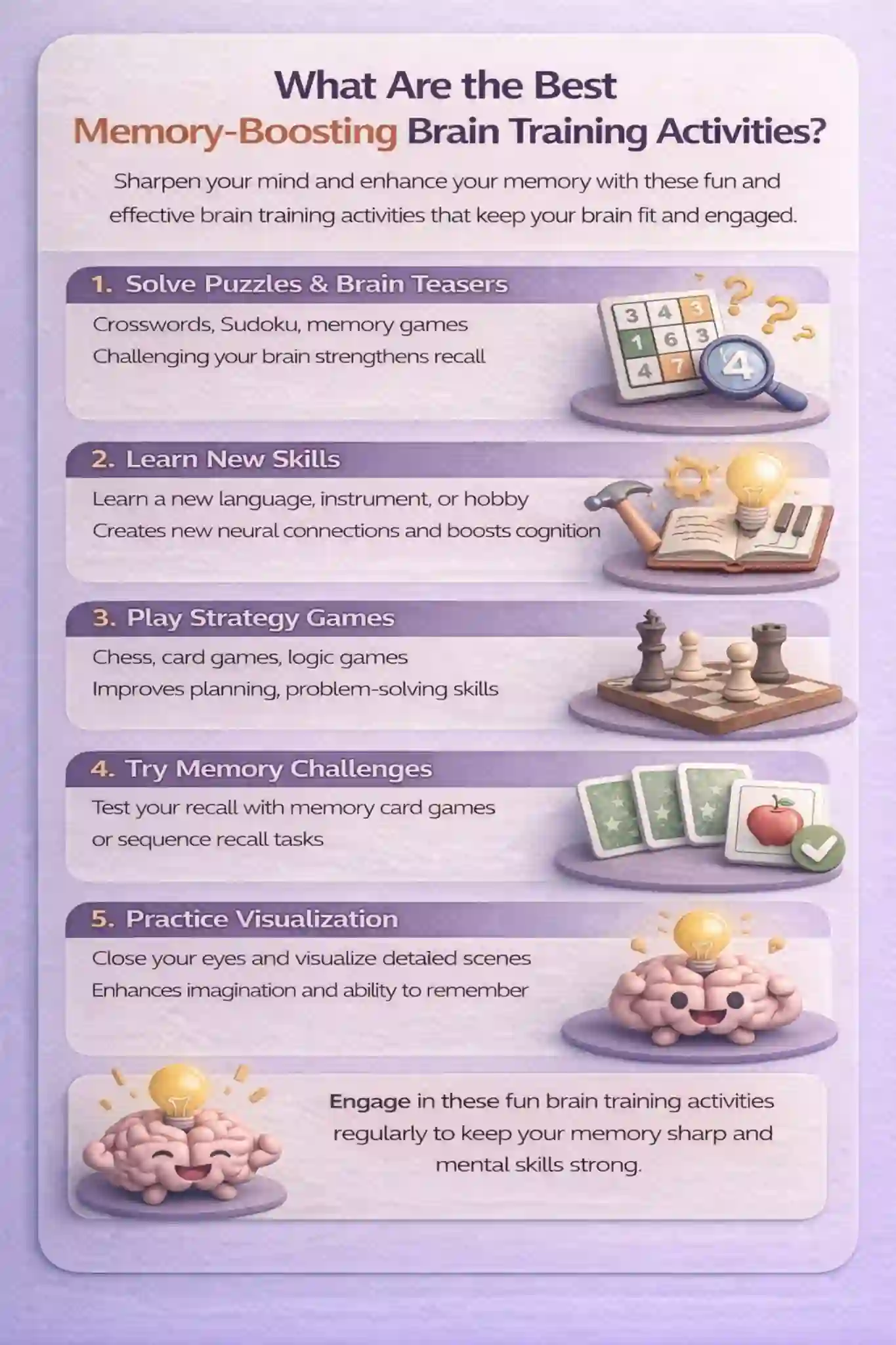
The best memory-focused brain training activities fall into a few proven categories:
Active recall exercises that force the brain to retrieve information without cues
Pattern and sequence challenges that improve working memory
Task-switching activities that strengthen cognitive flexibility
Visualization-based memory techniques that improve long-term retention
These activities work because they mirror how memory is used in real-world situations, not artificial test scenarios.
How Often to Practice for Real Results
Consistency matters more than duration. Short, focused sessions of 10 to 15 minutes per day outperform longer, irregular practice, an approach private schools often apply by emphasizing structured, repeatable learning habits. InfiniteMind testing shows memory improvements are most noticeable when exercises are rotated regularly to prevent mental autopilot.
Common Mistakes That Limit Memory Gains
Many people reduce results without realizing it by repeating the same exercise without increasing difficulty, focusing only on speed instead of recall accuracy, or relying solely on apps without real-world memory application. Effective brain training challenges the brain just beyond its comfort zone.
Choosing the Right Brain Training Activities for You
The best memory-boosting brain training activities are those you can practice consistently and progressively. When exercises are engaging, evidence-based, and aligned with how memory actually works, improvement becomes measurable rather than theoretical as spatial awareness sharpens how information is organized, visualized, and recalled within the brain.
“Repeated testing shows that real memory improvement doesn’t come from doing more brain exercises—it comes from practicing the right ones consistently. When training reflects how memory works in everyday life, progress becomes measurable rather than theoretical.”
Essential Resources on Brain Training Exercises
Understand the research behind brain training
Scientific American — Does “Brain Training” Actually Work?
A clear, science-focused analysis explaining what research shows about brain training’s real benefits and limitations, helping readers separate evidence from hype.
https://www.scientificamerican.com/article/does-brain-training-actually-work/
Try a neuroscience-designed training program
BrainHQ — Neuroplasticity-Based Brain Training
A research-driven platform designed by neuroscientists to improve memory, focus, and processing speed through adaptive, evidence-based exercises.
https://www.brainhq.com/
Explore expert cognitive strategy insights
Center for BrainHealth — Cognitive Training Research
An in-depth look at how structured cognitive strategies strengthen memory and attention, informed by clinical and real-world performance studies.
https://centerforbrainhealth.org/science/cognitive-training
Access trusted medical guidance on brain fitness
Harvard Health — Train Your Brain
A medically grounded overview of brain training activities and learning strategies that support long-term cognitive health and memory resilience.
https://www.health.harvard.edu/mind-and-mood/train-your-brain
Review peer-reviewed evidence on memory change
Frontiers in Human Neuroscience — Exercise Training Improves Memory Performance
A peer-reviewed study showing how targeted training influences neuroplasticity and produces measurable improvements in memory performance.
https://www.frontiersin.org/journals/human-neuroscience/articles/10.3389/fnhum.2021.771553/full
See large-scale results in older adults
NIHR Evidence — Brain Training Improved Thinking and Memory
An authoritative summary of a large study demonstrating real gains in memory and attention among older adults using structured brain training programs.
https://evidence.nihr.ac.uk/alert/brain-training-improved-thinking-memory-and-attention-in-older-people/
Get practical brain training tools and examples
Brain-Exercises.org — Brain Training Exercises & Tools Guide
A practical collection of exercises and tools for improving memory, focus, and cognitive flexibility, suitable for everyday use at home.
https://brain-exercises.org/
Supporting Statistics
Research and public health data consistently show why memory-focused brain training has become a priority for many adults.
Over 6 million Americans are living with Alzheimer’s disease, most of them age 65 or older.
According to the National Institute on Aging Alzheimer’s disease fact sheet, memory decline is already affecting millions of U.S. households.An estimated 7.2 million U.S. adults age 65+ are expected to have Alzheimer’s dementia in 2025, or roughly 1 in 9 older Americans.
This projection comes from the Alzheimer’s Association Facts and Figures report and explains the growing demand for preventive cognitive training.More than 200 clinical trials have been reviewed on cognitive and brain training interventions.
The National Institute on Aging’s review of lifestyle and cognitive interventions highlights that while not all brain exercises work, targeted training continues to show measurable benefits.U.S. Alzheimer’s and dementia care costs are projected to exceed $380 billion in 2025.
The Alzheimer’s Association national cost projections demonstrate why early, evidence-based brain health strategies are increasingly important.
These statistics highlight the growing impact of memory decline and the rising need for effective, evidence-based brain training, reinforcing why simple, consistent habits like reading for 20 minutes a day are increasingly valued as part of broader strategies to support memory, cognitive resilience, and long-term brain health.
Final Thought & Opinion
Effective brain training isn’t about doing more exercises—it’s about doing the right ones, consistently.
Research and real-world evaluation point to the same conclusion:
Flashy or fast-paced exercises rarely lead to lasting memory gains
Simple, targeted activities that challenge recall and attention work best
Consistency matters more than duration or variety
After reviewing cognitive training methods over time, one pattern becomes clear. The most effective brain training:
Mirrors how memory is used in everyday life
Pushes the brain just beyond its comfort zone
Produces noticeable, measurable improvement—not temporary stimulation
When brain training is treated as a long-term skill rather than a quick fix, results become practical and personal. Memory improves, focus sharpens, and thinking feels more reliable under pressure. That’s when brain training moves from theory to real cognitive benefit.
Next Steps
Take action with a simple, repeatable approach.
Define one memory goal
Choose recall, focus, or mental clarity.Select 2–3 targeted exercises
Focus on active recall and pattern-based tasks.Train briefly, but often
10–15 minutes per session, 4–5 days a week.Increase difficulty gradually
Adjust once exercises feel easy.Use memory in real life
Apply skills during conversations and daily tasks.Review progress weekly
Look for faster recall and better focus.Rely on trusted resources
Stick to research-backed methods.
This step-by-step approach reflects how different types of private schools structure learning by setting clear goals, using targeted exercises, reinforcing skills through frequent practice, and applying knowledge in real-world contexts to build memory, focus, and long-term cognitive performance.
FAQ on Brain Training Exercises
Q: Do brain training exercises improve memory?
A: Yes—when they focus on recall, attention, and mental effort. Passive or repetitive tasks rarely produce lasting results.
Q: How often should brain training be done?
A: Short, regular sessions work best.
10–15 minutes per session
4–5 times per week
Q: Are apps required for brain training?
A: No. Apps can help, but many effective exercises use real-life memory tasks without screens.
Q: How quickly do results appear?
A: Improvements in focus and recall are often noticeable within a few weeks when difficulty increases gradually.
Q: Who benefits most from brain training exercises?
A: Anyone seeking better memory or focus benefits most when training is consistent and applied to daily life.