Picture an ordinary Tuesday in October. The caretaker at the lake house needs a yes or no on a $9,400 dock repair, and the property manager in town has three invoices waiting for approval. Each request is simple on its own. Together they land on the same two people, usually a principal and a spouse who had other plans for the week.
Most wealthy families already have good help. What they're short on is coordination, and that's the work a family office concierge takes on. In practice, it works as a disciplined back office for your personal life, with one accountable team applying the same written approvals and records a family office uses for investments and taxes.
Your house manager, caretaker, and trusted vendors stay right where they are. Their work simply starts running through one plan, with someone watching the details and following up until each item is closed.
We think of it as protecting a family's most valuable asset, which is time. For households with several homes, a steady stream of invoices, and a strong preference for privacy, a disciplined family office concierge gives that time back.
TL;DR Quick Answers
Family Office Concierge
A family office concierge is a disciplined back office for a wealthy family's personal life. One accountable team runs bill pay, residences, vendors, and major projects under written approvals and documented follow-through, so the family protects its most valuable asset, which is time.
What it handles: bill pay with approval thresholds, invoice matching, multi-home maintenance, seasonal opening and closing, renovation oversight, insurance renewal tracking, and provider scheduling
How it differs from a personal concierge: ongoing, controlled household management instead of one-off errands
What stays the same: your house manager, staff, and trusted vendors keep their roles and work from one plan
What sets good support apart: one point of accountability, written approval limits, a record for every payment, and clear privacy rules
Best fit: families with several residences, heavy invoice and vendor volume, a major project underway, or a strong need for discretion.
Top Takeaways
A family office concierge runs a wealthy family's household with the same controls a family office applies to its finances.
The work covers bill pay, residence oversight, vendor coordination, major projects, insurance renewals, and provider scheduling.
Household staff and trusted vendors stay in place, and the concierge function coordinates their work under one plan.
Written approval thresholds and full documentation separate dependable support from informal help.
Families with several homes, heavy invoice volume, big projects, or strong privacy needs tend to benefit most.
Before signing with any provider, ask about accountability, controls, record access, reporting, and fees.
What Is a Family Office Concierge?
A family office concierge is an ongoing service that manages a wealthy family's household operations, including bill pay, residences, vendors, projects, and schedules, under the same controls a family office uses for its finances. Instead of handling requests one at a time, it works from defined approvals, documented records, and a single accountable team.
The word has a long history. A concierge started out as the keeper of a building's door and keys, then became the hotel staffer guests relied on to get things done in an unfamiliar city. Private banks now offer concierge services to their top clients, and the role has stretched into full lifestyle management.
The family office version keeps that get-it-handled instinct and adds what a complex household actually needs. Household payments and vendor contracts connect to the family's broader financial administration instead of living in someone's inbox. The family sets approval limits in writing before the first invoice shows up. And because the routine belongs to a process rather than a person, it holds steady through staff turnover and busy travel seasons.
If you're weighing the wider family office structure, our earlier guide on how an outsourced family office helps after the sale of a business shows where concierge fits next to tax, estate, and investment coordination.
Family Office Concierge vs. Personal Concierge vs. Household Staff
Household staff do the hands-on work, and a personal concierge knocks out individual tasks. A family office concierge sits above both and makes sure every piece of that work is approved and on record. Most families end up with some mix of all three, so the more useful question is who holds the whole picture.
Self-managed household
Scope: whatever the family has time for
Vendor coordination: family members follow up themselves
Approvals and controls: vary by person
Records and reporting: scattered across email and invoices
Continuity when people change: depends on who remembers
Best fit: one home and a few vendors
Personal concierge
Scope: one-off tasks and errands
Vendor coordination: handled per request
Approvals and controls: rarely defined
Records and reporting: minimal
Continuity when people change: resets with each request
Best fit: occasional needs
Family office concierge
Scope: ongoing household operations
Vendor coordination: managed end to end, with follow-through
Approvals and controls: written thresholds and sign-offs
Records and reporting: centralized tracking and regular reporting
Continuity when people change: repeatable process and standards
Best fit: several homes, many vendors, and strong privacy needs
Bringing in a family office concierge doesn't mean letting anyone go. Your existing staff stay, and the concierge function lines their work up with the family's priorities and governance.
It also has clear neighbors. Administrative support handles documents and keeps your CPA, attorney, and other advisors in sync, while a Personal CFO watches cash flow and the balance sheet. Concierge covers the household and lifestyle side. In our experience, all of them work best when they share the same information, creating a more coordinated approach to multi family office services.
What a Family Office Concierge Handles Day to Day
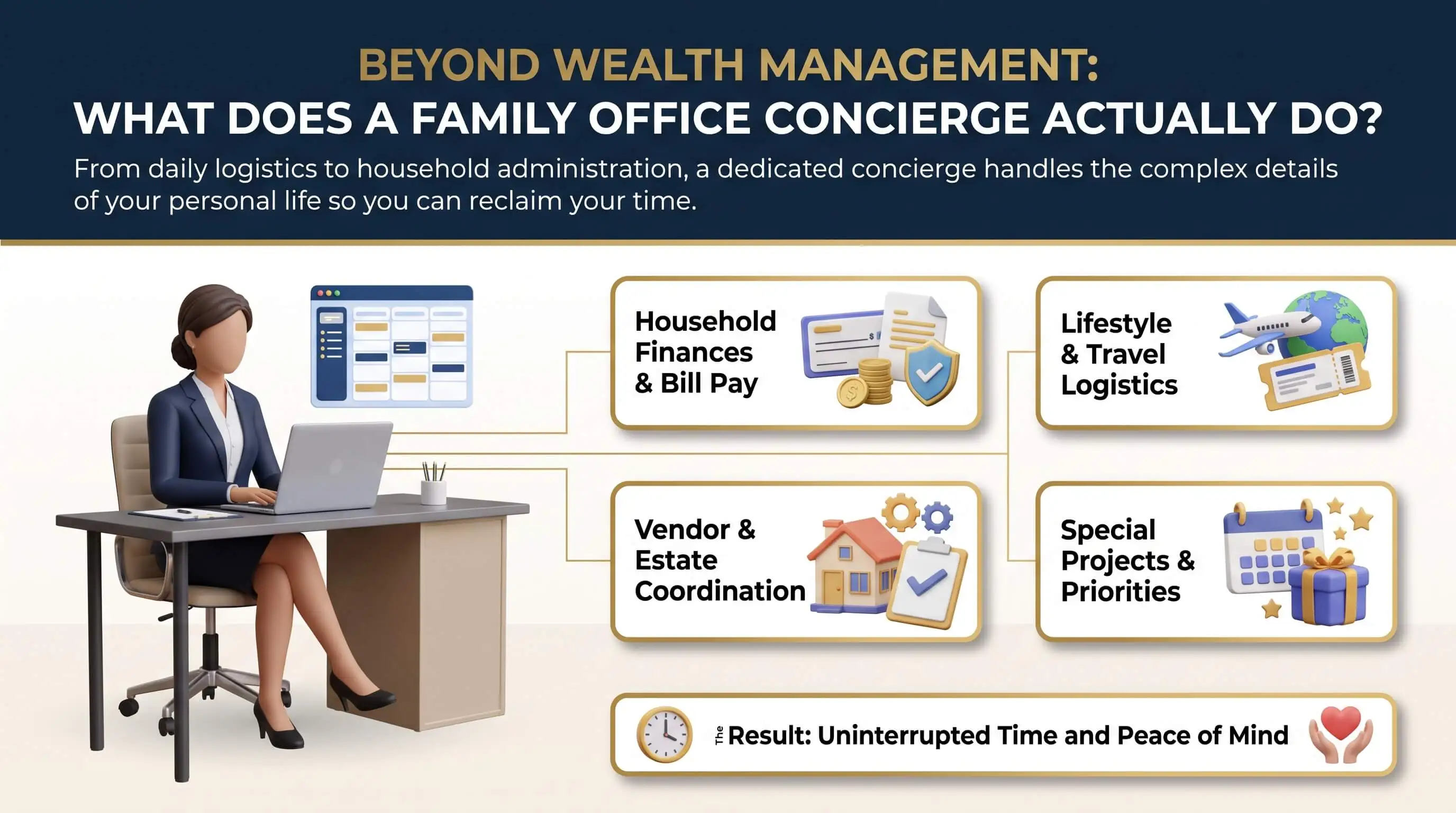
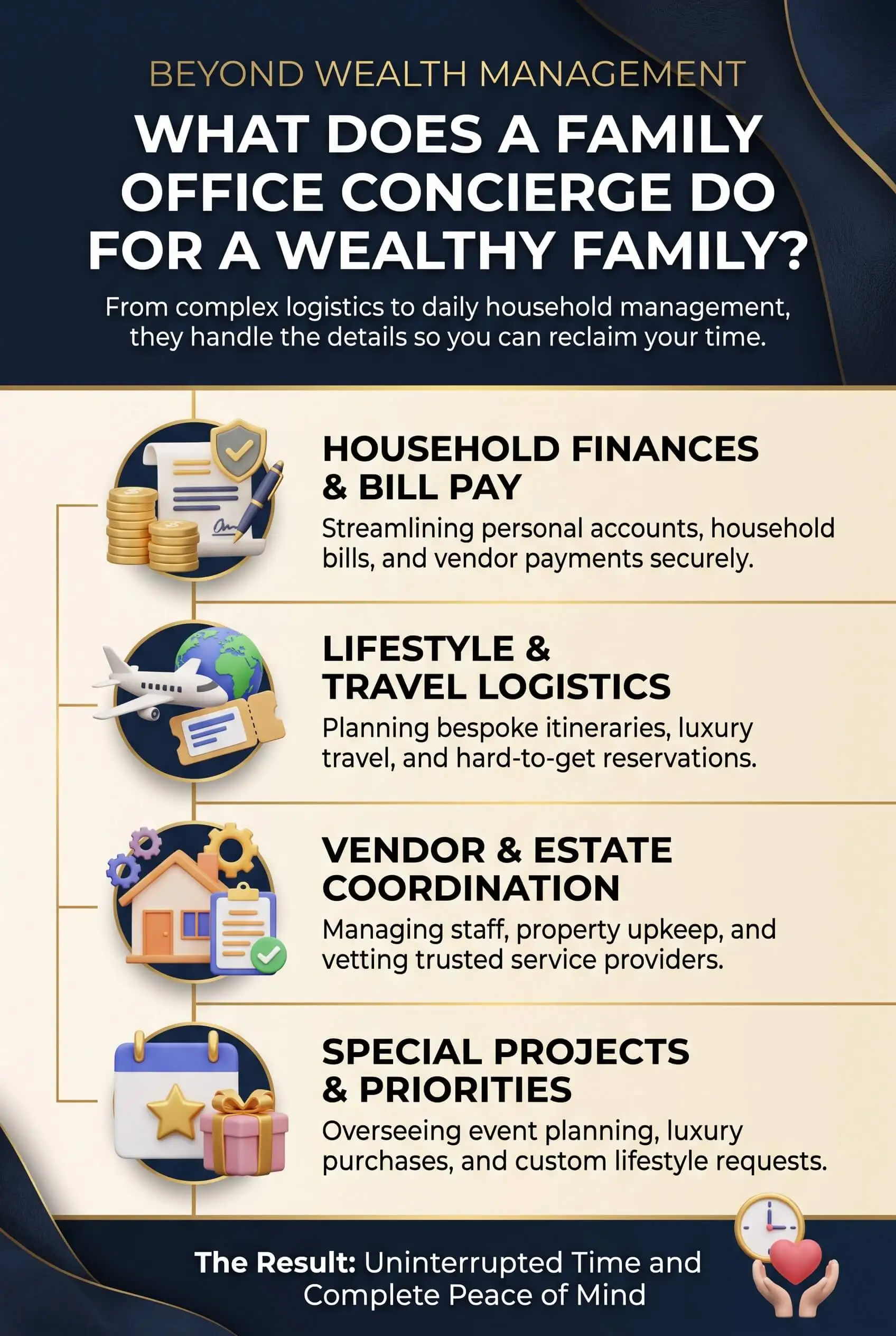
Most of the job is quiet and recurring. The concierge team pays the bills on time and keeps each home running, so projects reach the finish line without anyone in the family chasing paperwork. Here's how that work usually breaks down.
Household Finances and Bill Pay
This is where control matters most, and where informal arrangements tend to slip first.
Bill pay runs on approval thresholds the family sets, so a $300 landscaping invoice moves the same day while a $25,000 roof deposit waits for a sign-off.
The concierge team matches each invoice to its contract or quote before paying it.
Utilities, memberships, staff payroll, and service contracts all sit on one calendar.
Your CPA and accounting team can work from clean numbers at year end instead of a pile of statements.
Residence Oversight and Vendor Coordination
Every home comes with its own vendors, schedules, and small emergencies.
The team books maintenance, confirms the appointment, and checks the work once it's done.
Service history for every residence lives in one place, so nothing depends on someone's memory.
Staff and vendors also get a single point of contact, instead of hearing different instructions from different family members.
Lifestyle Logistics and Major Projects
Big projects generate the most follow-up, and they're the easiest place to lose track of a budget.
Vendor sourcing and vetting before anyone signs a contract
Renovation oversight that tracks bids, change orders, timelines, and final invoices
Research and side-by-side comparisons for major purchases, when the family asks
Warranty and permit files stored with each property's records
Here's a typical case. A family needs a new roof on a lake house they visit four times a year. The concierge team gathers bids, confirms each contractor's license and insurance, and routes the chosen contract for approval. It then schedules the work around the family's visits, checks the final invoice against the signed scope, and files the warranty with the property records. The family made two decisions, and the team carried everything else.
Insurance Renewals and Seasonal Continuity
Second homes and valuable assets run on calendars that are easy to forget until something lapses.
The team tracks renewal dates for property, auto, and collection coverage and sets up reviews with your broker well before each deadline.
Opening and closing checklists for seasonal homes cover utilities, security, landscaping, and staff schedules.
That way nothing slips just because the one person who usually remembers happened to be traveling.
Scheduling Across Wellness, Medical, and Security Providers
Busy families often need help keeping appointments and providers in sync. A family office concierge coordinates calendars and logistics across wellness, medical, and security providers, so each provider has the appointment and the context they need. It doesn't give medical or security advice, and it shouldn't.
The Secrets Behind Concierge Support That Actually Works
The families who get the most out of concierge support usually don't have the biggest teams. What they have is a handful of operating habits running quietly in the background.
One point of accountability. A single team owns follow-through, so tasks don't fall between people.
Written approval thresholds. Everyone knows which payments need a sign-off before any money moves.
A record for every payment and contract. If something was paid, there's a note of why, who approved it, and what it covered.
Centralized tracking. Open items live in one system instead of a dozen email threads and text chains.
Clear privacy rules. Only the people who need household and financial information can see it.
There's nothing glamorous on that list, and we'd argue that's exactly why it works. When the back office is disciplined, the day-to-day experience feels easy.
Why Strong Leaders Delegate the Labor of Living
Executives rarely run their own calendars or chase their own invoices. Most build a chief of staff function so their attention stays on the decisions only they can make.
The same logic applies at home, and plenty of principals ignore it. They run companies or sit on boards all day, then spend the evening answering a contractor's questions about tile or approving the pool service bill. That's a poor use of a leader's time and an even poorer use of the family's.
Good leaders know the difference between staying informed and staying involved in every step. A family office concierge lets you set priorities and approve what matters while someone else carries the follow-up. The same principle sits behind the role of leadership coaching for business leaders, which comes down to protecting your time for the work only you can do.
Signs Your Family Is Ready for Concierge Support
Families usually get here when personal complexity grows faster than the time they have to manage it. Common signs include:
You keep more than one residence, each with its own vendors and schedules.
Invoices, renewals, and staff questions arrive faster than anyone can review them.
Approvals happen informally, and the rules change depending on who's asked.
A renovation, purchase, relocation, or other big project is underway or coming up.
You'd rather fewer people see your household information.
Here's one quick test we like. If no one can say who approved last month's largest household payment, or where the paperwork lives, coordination is the gap.
How Family Office Concierge Services Work, Step by Step
Good concierge support starts with a map rather than a to-do list. Most engagements move through four steps.
Map priorities and routines. List recurring tasks, key vendors, household staff, preferences, and who approves what.
Implement controls and workflows. Set permissions, approval thresholds, documentation standards, and how the family wants progress reported.
Coordinate and execute. Manage the logistics, track every action item, and drive each one to completion.
Maintain and refine. Adjust the process as homes, schedules, and family needs change.
How to Evaluate a Family Office Concierge Provider
Choose a concierge provider the way you'd choose anyone who will see your bills and walk through your homes. Ask pointed questions and expect specific answers.
Questions worth asking:
Who on your team is accountable for our household, and who covers when they're away?
How do bill pay approvals work, and can we set our own thresholds?
Where do you store records, and who can access them?
How will you work with our existing house manager, staff, and vendors?
What reporting will we receive, and how often?
How are your fees structured, and what's included?
Red flags to watch for:
Promises of unlimited, around-the-clock service with no process behind them
Vague answers about approvals, controls, or record keeping
Pressure to replace staff or vendors you already trust
No written onboarding plan or service standards
"Families rarely tell us they need more help. They already have a house manager, a couple of assistants, and vendors they've trusted for years. What's missing is one place where approvals, records, and follow-through live. So we spend most of the first month listening, mapping every residence, every recurring bill, and every person who touches the household. Once a family sees all of that in one view, the right controls tend to become obvious. Our job is to get the people already in place working from the same plan, so the family only hears about the decisions that truly need them."
7 Essential Resources
Every source below is free, and most come from government agencies or published industry research. They're useful for checking the obligations and options behind any concierge arrangement.
UBS Global Family Office Report 2025. UBS surveyed 317 family offices on staffing, costs, and which functions they keep in-house versus outsource.
Wikipedia: Family Office. A plain-language overview that covers household staff and property management alongside investments.
IRS Publication 926: Household Employer's Tax Guide. Read this before paying a housekeeper, caretaker, or driver, since it explains when those wages create tax and recordkeeping duties.
U.S. Department of Labor Fact Sheet #79: Private Homes and Domestic Service Employment. Lists which household workers fall under federal wage rules, from nannies and cooks to caretakers and chauffeurs.
Crain Currency: The Concierge Arms Race Inside the Family Office Boom. Reporting on why families now expect lifestyle support from the offices that manage their wealth.
Les Clefs d'Or: History. The international hotel concierge association traces the role back to the grand hotels of Paris.
Altss Glossary: Concierge Services. A short reference showing how family office concierge work ranges from basic bill pay to full household management.
3 Statistics
UBS's Global Family Office Report 2025 found that family offices employ just 12 people on average, even as the wealth and families they serve keep growing (UBS). Teams that lean rarely have room to run household operations well on top of investments and reporting.
In the same survey of 317 family offices, only 31% had risk management processes reaching beyond investments into areas such as reputation, private property, and medical matters (UBS). Household and lifestyle risk is often the least watched part of a family's affairs.
Under IRS rules for 2026, paying any one household worker $3,000 or more in cash wages triggers Social Security and Medicare tax obligations for the family (IRS Publication 926). One caretaker or housekeeper can create payroll duties that someone has to track.
We read these numbers together. Family offices run lean, and household compliance duties tend to hide inside ordinary payments where nobody is looking. This can include expenses related to private school tuition and other educational obligations.
Final Thoughts and Opinion
Good concierge support is mostly invisible. Families notice it as fewer interruptions and less daily friction, rarely as a grand gesture.
That's why we think the luxury framing around concierge services misses what matters. Restaurant reservations and travel perks are easy to buy. A team that pays the right bills under the right approvals, keeps three homes on schedule, and remembers the insurance renewal nobody else did is much harder to find, and it's what protects a family's time and privacy year after year.
We've also found that the families who benefit most aren't always the largest. They're the ones whose lives have outgrown their systems. A second home, a renovation, new staff, or a recent liquidity event can turn a well-run household into constant follow-up within a few months.
One family who worked with Legacy Bridge said the team handled every detail with such care that they could simply be together. That's the outcome worth aiming for. When someone carries the labor of living with discretion and consistent follow-through, your time goes back to the people you care about.
Frequently Asked Questions
What does a family office concierge do?
A family office concierge manages the household side of a wealthy family's life. That includes bill pay with approvals, vendor scheduling, oversight of multiple residences, major project coordination, insurance renewal tracking, and scheduling across wellness, medical, and security providers. One accountable team handles the follow-through and keeps the records, so the family only steps in for decisions that need them.
How is a family office concierge different from a personal concierge?
A personal concierge usually handles one-off tasks and errands, one request at a time. A family office concierge is ongoing and much broader. It runs household operations under defined approvals and documentation and ties into the family's wider financial administration.
Is concierge the same as administrative support?
No. Concierge covers household operations and lifestyle logistics such as bills, homes, vendors, and projects. Administrative support organizes documents and keeps your professional advisors, like your CPA and attorney, working from the same information. The two work best side by side.
Will a family office concierge replace our household staff?
No. Your house manager, caretakers, and trusted vendors stay in place. The concierge team coordinates their work and keeps schedules and payments in line with the family's priorities and governance.
How is bill pay handled with controls?
The family sets approval thresholds in advance. Routine invoices move quickly, while larger or unusual payments wait for a sign-off. The team matches each payment to a contract or quote, documents it, and sends regular reports showing what was paid and why.
How are family office concierge services priced?
Pricing depends on the provider and the scope of work. Some charge a retainer or flat annual fee, and others include concierge support within broader family office fees. Ask for the fee schedule in writing, along with what's included and how the provider handles requests outside that scope.
How do we get started?
Start by listing every residence, recurring bill, staff member, and key vendor. A good provider will use that map to set approvals, workflows, and reporting preferences, then begin coordinating day-to-day tasks under a clear onboarding plan.
Ready to Reclaim Your Family's Time?
Start with a simple inventory. This week, write down every residence, recurring bill, staff member, and vendor your household relies on, then note who approves payments today and where the records live. This will help you identify where family office services can bring better coordination and oversight.
With that list in hand, ask any concierge provider how they would put approvals, documentation, and follow-through around all of it. The right partner will answer with a written process and a plan that keeps your trusted people in place.
Managing more than one home, or in the middle of a big project? Leave your questions in the comments and we'll answer them.