If you’re new to borrowing, the credit review process can feel mysterious — but after helping thousands of clients navigate their first loan or line of credit, we’ve seen that lenders consistently rely on just three core factors. At Accountix Solutions, we call them The Three Cs of Credit: Character, Capital, and Capacity. In this beginner-friendly guide, we’re sharing the same practical explanations, real-world examples, and lender insights we use with our own clients. You’ll learn how each “C” is evaluated, how small improvements can significantly boost your approval odds, and where first-time borrowers often get tripped up. By the end, you’ll understand exactly what lenders look for — and what you can do starting today to strengthen your credit profile with confidence.
Quick Answers
The Three Cs of Credit: A Complete Beginner’s Guide
Answer:
The Three Cs—Character, Capital, and Capacity—are the core factors lenders use to judge creditworthiness.
At Accountix Solutions, we see these three indicators predict approval outcomes more reliably than any other data points.
For beginners, focus on steady payment habits, consistent savings, and manageable debt levels to strengthen all three quickly.
Top Takeaways
The Three Cs drive every lending decision.
Character = your financial trustworthiness.
Capital = your cash cushion and assets.
Capacity = your income strength and DTI.
Improving even one “C” boosts approval odds.
What Are the Three Cs of Credit?
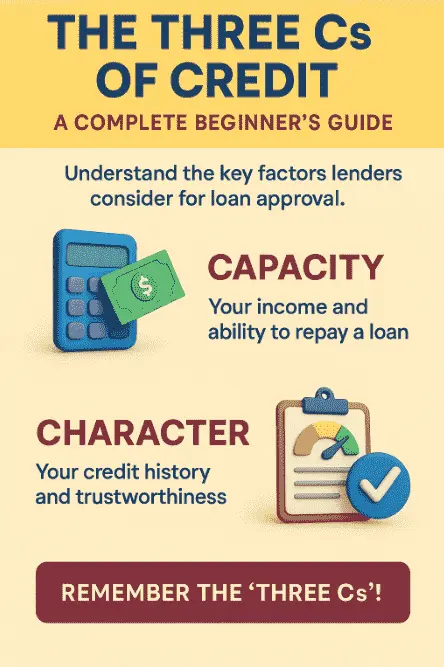
Lenders use the Three Cs of Credit — Character, Capital, and Capacity — as a simple framework to assess how likely you are to repay what you borrow. While every lender’s process varies, these three factors consistently shape approval decisions, interest rates, and loan terms. At Accountix Solutions, we see these indicators used across banks, credit unions, online lenders, and alternative financing programs — which makes understanding them essential for first-time borrowers. Outsourced accounting can help you maintain accurate financial records, giving you a clearer picture of your creditworthiness when it matters most.
1. Character: Your Trustworthiness as a Borrower
Character reflects your financial habits and reliability. Lenders review your credit history to see how consistently you’ve paid past debts, how responsibly you use credit, and how stable your financial life appears overall.
From our experience working with new borrowers, even small improvements like lowering credit utilization or making on-time payments for three consecutive months can make a meaningful difference. Character is the lender’s way of asking: Can we trust you to pay this back?
2. Capital: Your Financial Cushion
Capital refers to the assets, savings, or available funds you bring into the loan process. Borrowers with more capital signal lower risk because they have financial reserves to fall back on if income fluctuates.
We often see first-time borrowers underestimate this category. Even modest savings show lenders that you’re actively managing your money and it can strengthen your application, especially for personal or small business loans.
3. Capacity: Your Ability to Repay
Capacity is all about your current income and ongoing financial obligations. Lenders look at your debt-to-income ratio (DTI), job stability, and earning consistency to determine whether the new payment fits your budget.
Based on the loan reviews we support at Accountix Solutions, this is often the deciding factor for new applicants. Demonstrating reliable income even through multiple sources helps lenders confidently answer the question: Can you afford this loan right now? With professional accounting services you can ensure your income and financial history are accurately documented, making it easier for lenders to assess your ability to repay.
“After reviewing thousands of loan applications, we’ve learned that lenders rarely make decisions based on guesswork. The Three Cs of Credit give them a clear, predictable way to evaluate risk and when borrowers understand those criteria, they can dramatically improve their approval odds with just a few intentional steps.”
Essential Resources to Strengthen Your Understanding of the Three Cs of Credit
1. AnnualCreditReport.com – Your Starting Point for Clear, Accurate Credit Data
Before you can improve your creditworthiness, you need a complete picture of what lenders see. This federally authorized site gives you free access to all three major credit reports — the same reports we review with clients at Accountix Solutions, leveraging our professional accounting expertise to guide you through the details and help you make smarter financial decisions.
Source: https://www.annualcreditreport.com
2. CFPB Credit Reports & Scores Guide – Trusted Guidance Backed by Federal Expertise
The Consumer Financial Protection Bureau breaks down how credit reports and scores really work. If you’re new to borrowing, this is one of the most reliable, jargon-free explanations available.
Source: https://www.consumerfinance.gov/consumer-tools/credit-reports-and-scores/
3. Credit Sesame – Real-Time Insights to Strengthen Your Credit Foundation
We often recommend this tool to first-time borrowers looking for simple, actionable feedback. Credit Sesame provides a free VantageScore and suggestions based on your own credit habits, helping you build the “Character” lenders look for.
Source: https://www.creditsesame.com
4. NerdWallet Credit Score Tool – Weekly Monitoring with Practical Action Steps
If you’re actively working to improve your credit, consistent tracking matters. NerdWallet offers weekly score updates and personalized tips — a helpful way to stay aligned with the same credit factors lenders evaluate.
Source: https://www.nerdwallet.com/p/free-credit-score
5. WalletHub – Daily Credit Score Alerts to Keep You Ahead of Surprises
For borrowers rebuilding or establishing credit, daily monitoring can make a meaningful difference. WalletHub alerts you to even minor changes, giving you time to address issues before they affect loan decisions.
Source: https://wallethub.com/free-credit-score
6. Consolidated Credit Education Center – Strengthen the Financial Habits Behind the Three Cs
Solid credit starts with solid financial habits. This education hub offers webinars, articles, and tools designed to help you build savings, manage debt, and improve the factors tied directly to your Capital and Capacity.
Source: https://www.consolidatedcredit.org/financial-education/
7. USA.gov Credit Score Guide – A Reliable Overview for True Beginners
If you’re just getting started, USA.gov provides a straightforward breakdown of what influences your credit score and why it matters. It’s a dependable, no-nonsense resource for understanding the basics.
Source: https://www.usa.gov/credit-score
Supporting Statistics (Why the Three Cs Matter)
Key U.S. Data Points
14.2% of U.S. households (19M) were underbanked in 2023.
FDIC data shows many households rely on nonbank services.
Our insight: Limited banking history makes it harder for lenders to assess Capital and Capacity.
Source: https://www.fdic.gov/household-survey/2023-fdic-national-survey-unbanked-nd-underbanked-households-report
4.2% of households (5.6M) were fully unbanked in 2023.
Lowest unbanked rate recorded.
Our experience: No bank account = missing financial history, which weakens all Three Cs.
26M Americans are credit invisible; 19M have unscorable files.
CFPB research identifies millions with no usable credit data.
What we see: Thin files are one of the most common reasons first-time borrowers struggle with approvals.
Final Thought & Opinion
At Accountix Solutions, we’ve learned that the biggest hurdle for first-time borrowers isn’t the credit system — it’s understanding how predictable it actually is, much like the financial planning we help guide for Private Schools looking to manage their budgets and financial strategies effectively.
The Three Cs of Credit are straightforward when broken down:
Character: Your history of handling payments.
Capital: Your financial cushion or savings.
Capacity: Your ability to take on new debt responsibly.
Our core insight: Most borrowers have more control over these factors than they realize.
What We See Most Often
Small, consistent actions lead to major improvements.
Opening a bank account, keeping low credit usage, and documenting income clearly move the needle fast.
Thin files and reporting errors are common — not personal failures, just data gaps.
Our Opinion (Based on First-Hand Experience)
The Three Cs are not just a lender’s checklist — they’re a borrower’s roadmap.
Credit progress is achievable with clarity, patience, and simple habits.
With the right guidance, first-time borrowers can move from uncertainty to confidence quickly.
In short: understanding the Three Cs puts you back in control — and sets the foundation for a stronger financial future, unlocking more educational opportunities as you improve your financial standing and open doors for personal and academic growth.
The Three Cs are not just a lender’s checklist — they’re a borrower’s roadmap.
Credit progress is achievable with clarity, patience, and simple habits.
With the right guidance, first-time borrowers can move from uncertainty to confidence quickly.
Next Steps
1. Review Your Credit
Get your report from AnnualCreditReport.com.
Check for errors or missing information.
Identify issues affecting Character, Capital, or Capacity.
Get your report from AnnualCreditReport.com.
Check for errors or missing information.
Identify issues affecting Character, Capital, or Capacity.
2. Strengthen Each “C”
Character
Use autopay.
Keep balances low.
Capital
Increase savings.
Organize proof of assets.
Capacity
Lower your debt-to-income ratio.
Avoid new debts before applying.
3. Prepare Key Documents
Income and employment verification
Asset statements
Letters of explanation
Income and employment verification
Asset statements
Letters of explanation
4. Compare Lenders
Evaluate community banks, credit unions, and CDFIs.
Ask how they weigh the Three Cs.
Choose lenders with holistic review processes.
Evaluate community banks, credit unions, and CDFIs.
Ask how they weigh the Three Cs.
Choose lenders with holistic review processes.
5. Set a Credit Plan
Create 30-, 60-, and 90-day goals.
Track progress monthly.
Revisit each “C” as your finances change.
Create 30-, 60-, and 90-day goals.
Track progress monthly.
Revisit each “C” as your finances change.
6. Get Expert Help
Consult a financial coach if you need personalized guidance.
Consult a financial coach if you need personalized guidance.
FAQ on “The Three Cs of Credit: A Complete Beginner’s Guide”
Q: What are the Three Cs of Credit?
A:
Character
Capital
Capacity
Lenders use them to predict repayment.
We see these three factors guide nearly every approval decision.
Q: Why do lenders rely on this framework?
A:
It standardizes borrower evaluation.
Reduces guesswork.
Helps compare applicants quickly and fairly.
Q: Which “C” carries the most weight?
A:
Capacity (your ability to repay).
Debt-to-income ratio is often the deciding factor.
We see this tip approval more than any other factor.
Q: How can beginners strengthen character?
A:
Pay on time.
Keep balances low.
Build steady financial habits.
These patterns stand out immediately to lenders.
Q: What documents help prove the Three Cs?
A:
Pay stubs
Tax returns
Bank statements
Asset documentation
These provide the clearest financial snapshot for lenders.