Closing the sale settles one question and opens a dozen more. Within weeks, your CPA is asking about estimated taxes, your estate attorney wants to revisit the trust, and advisors you've never met are calling with ideas about where the proceeds should go.
An outsourced family office puts one coordinated team over all of it. That team organizes your accounts and entities, gets your CPA, attorney, and investment advisors working from the same plan, and tracks each decision until it's done. You get the structure of a private family office without hiring anyone to staff one.
That structure matters most in the first year. After decades of running a company, many owners find the months after closing harder than the sale itself. The proceeds sit in one or two accounts. The tax picture is new. And the estate plan was probably written around a business you don't own anymore.
Keep the professionals you already trust. Good outsourced family office executive services bring those advisors into one plan and give you a single point of accountability, so the work actually gets finished.
TL;DR Quick Answers
Outsourced Family Office Executive Services
Outsourced family office executive services give a family one coordinated team and a single point of accountability for its whole financial life, without the cost of staffing a private family office. After a business sale, that team maps every account, entity, and advisor, then drives follow-through on one plan.
Personal CFO oversight: cash flow, balance sheet, and meeting preparation
Advisor coordination: your CPA, attorney, and insurance advisor work from shared information instead of separate pieces
Tax and estate follow-through: estimated payments, trust updates, and wealth transfer planning, carried out with your licensed professionals
Administration: secure document organization, reporting, and deadline tracking
Best fit: families with new liquidity, several entities or trusts, and more advisors than one person can keep aligned.
Top Takeaways
A family office coordinates a family's tax, estate, investment, and administrative work under one plan, and an outsourced model delivers that without a private staff.
Cash, taxes, entities, and estate documents all change at once after a sale, which is why the first year tends to be the hardest to manage.
A good outsourced family office works with your existing CPA, attorney, and insurance advisor instead of replacing them.
Stabilize and map everything before you make large, permanent decisions.
Check any adviser's registration and fees through the SEC's public disclosure tools before you sign.
Plan for your time and purpose after the sale, not only your money.
What Is an Outsourced Family Office?
An outsourced family office is an outside team that coordinates your tax, estate, investment, cash flow, and administrative work under one plan, with one point of accountability.
The traditional version, a single-family office, is a private company built to serve one family. It carries its own staff and systems, and the overhead adds up fast. Charles Simonds, a family office consultant at Bank of America Private Bank, puts the average cost of running one at $3 million to $5 million a year .
Most families coming off a sale don't need that much infrastructure. They need coordination. A multi-family office delivers it on a shared platform, so several families get experienced people, support from outsourced business and financial accounting firms, and institutional-grade infrastructure at a lower cost.
Why the First Year After a Sale Is So Complex
Nearly every part of your financial life changes at once, and each part comes with its own advisor.
While you owned the company, the company organized a lot of your life. Payroll ran. The controller kept the books. Most of your net worth sat in one place you understood well. After closing, that scaffolding is gone, and several things land on your desk within the same few weeks:
Concentrated cash. Proceeds usually sit in one or two accounts while you decide what's next.
A new tax picture. A large gain often means estimated payments and timing decisions that can't wait until April.
Entities to clean up. You may need to wind down or restructure holding companies, real estate LLCs, and old buy-sell agreements.
An estate plan that no longer fits. Wills and trusts drafted around an operating business may not match what you own now.
Meanwhile, the advisor list tends to grow. Each one sees a piece of the picture, and nobody is responsible for the whole.
The personal side matters too. Owners often feel a genuine sense of loss after a sale, even a good one, because the work that filled 50 or 60 hours a week disappears overnight. Big financial decisions made in that stretch, without a plan, are the ones families most often wish they could take back.
What Outsourced Family Office Executive Services Cover After a Sale
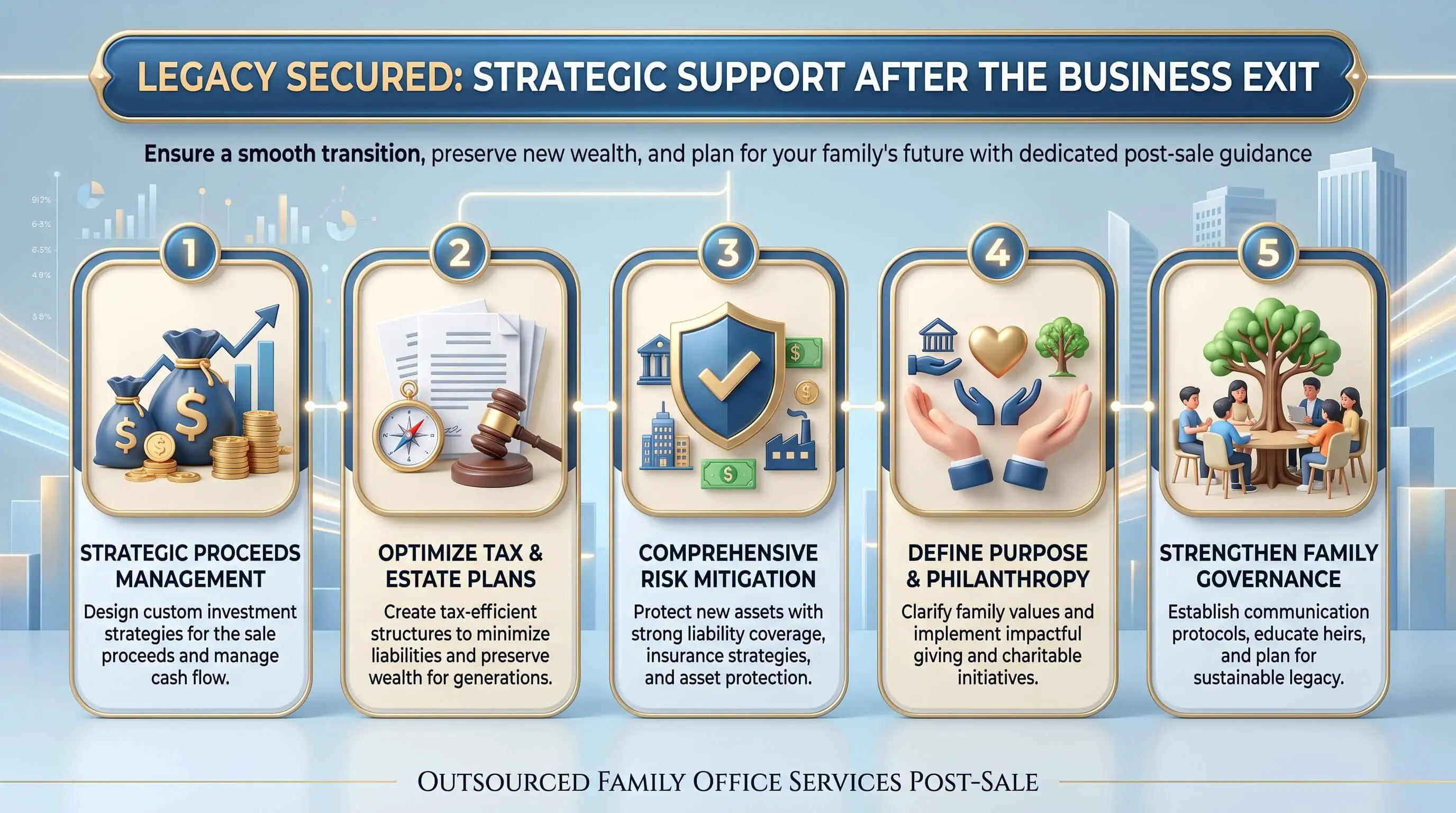
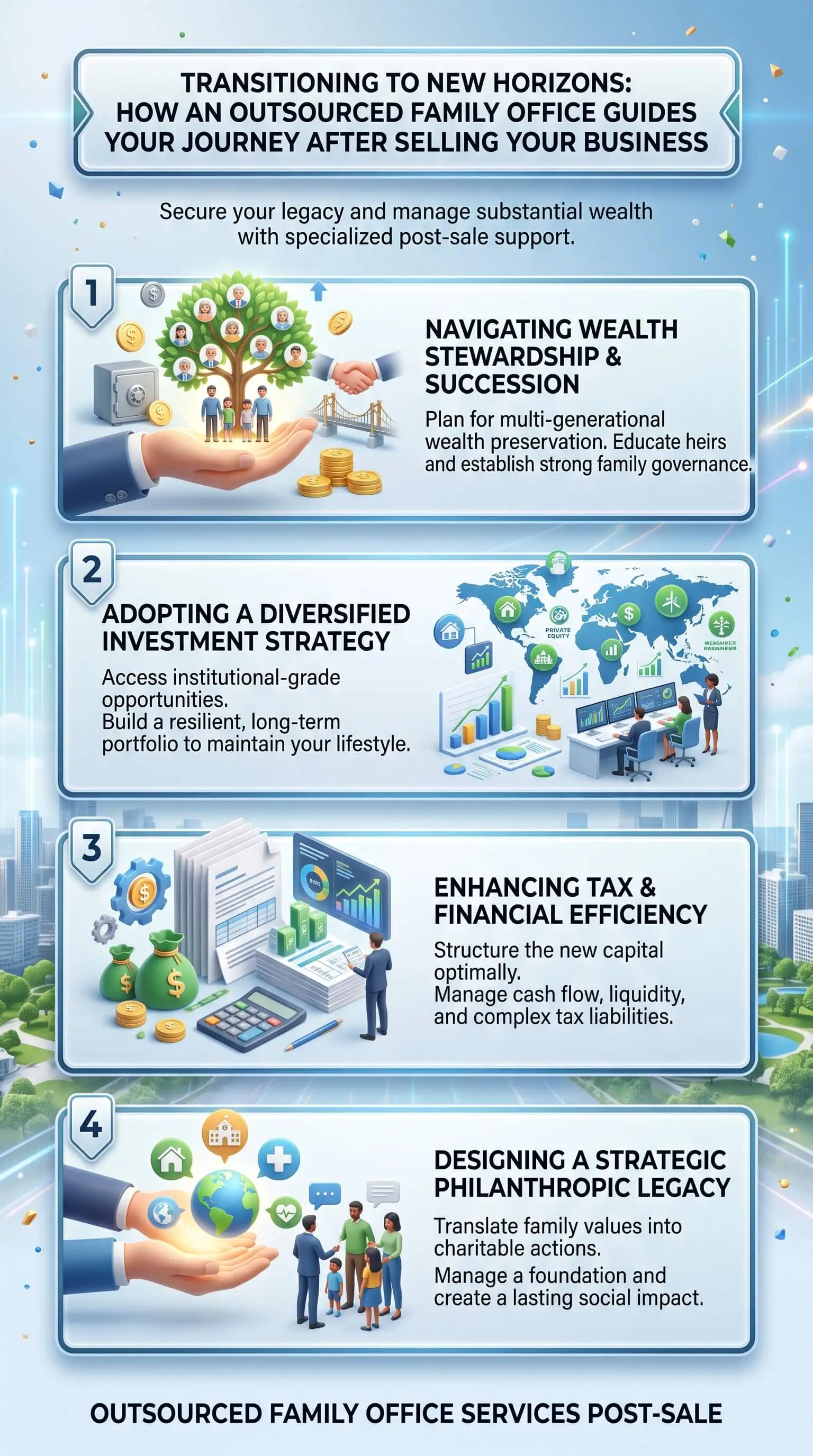
Outsourced family office executive services cover the strategic and administrative work that keeps your proceeds, your family's goals, and your advisors pointed in the same direction. Most families use some combination of the following.
Personal CFO Oversight and Cash Flow
A Personal CFO is your senior coordinator. They watch cash flow and the balance sheet, prepare you for advisor meetings, and make sure action items move. For a former owner, this is often the person who replaces the controller you used to lean on.
Tax Strategy for the First Post-Sale Filing
The year you sell is rarely a routine tax year. Your family office works with your CPA to gather documents early, plan estimated payments, and think ahead about charitable gifts or trust funding. Your CPA still gives the tax advice. The family office makes sure nothing slips between meetings.
Estate Planning and Wealth Transfer Updates
Selling changes what you own, which changes what your estate plan has to do. The family office coordinates with your attorney to review documents, update trusts, and map out how wealth moves to the next generation.
Family Governance and Preparing the Next Generation
Money that used to live inside a company now belongs to a family, and families need a way to talk about it. Governance gives you one, whether that's a regular family meeting, a few shared decision guidelines, or financial education for adult children.
Philanthropy and Structured Giving
Many sellers want to give back once the deal closes. A family office helps you do it through donor-advised funds, private foundations, or planned gifts that reflect your values and fit your tax plan.
Administrative Support and Document Organization
This is the quiet work that holds everything else up. The team organizes and securely stores your statements and legal documents, tracks deadlines, and handles recurring bills and renewals before they turn into problems.
A First-Year Roadmap After Closing
Most families work through the first year in five phases. Treat the timing as typical rather than fixed, and let your own advisors shape the details.
First 30 days: stabilize. Keep the proceeds safe and liquid, hold off on big irreversible moves, and start a list of every account, entity, and advisor.
Days 30 to 90: assess and map. Build a full inventory of assets, entities, documents, and recurring obligations. This is usually when gaps and conflicts between advisors show up.
Days 90 to 180: build the infrastructure. Set up reporting, workflows, and secure document storage, and agree on who owns each task.
Months 6 to 12: coordinate and execute. Make the estimated tax payments, update estate documents, and hold a first family meeting.
Year two onward: evolve. Revisit the plan as goals, assets, and family circumstances change.
From Running a Company to Leading the Family's Capital
The skills that built your company still matter after the sale. They just point somewhere new.
As an owner, you led people, set priorities, and made calls with incomplete information. As the head of your family's wealth, you'll do much the same work with a different team and a much longer time horizon. What's missing is the staff that used to keep the details in order. A family office fills that gap so you can lead the big decisions instead of chasing paperwork, which is the same reason clear financials drive better leadership decisions inside any business.
Identity and Purpose After the Exit
Plenty of sellers are surprised by how much they miss the work. Deciding what comes next, whether that's a new venture, a board seat, more giving, or more time with family, protects your well-being as much as your balance sheet. Some owners find that leadership coaching for business leaders helps them sort out that next chapter.
Single-Family, Multi-Family, or Outsourced: Which Model Fits?
The right model comes down to how much wealth you're managing, how much control you want, and how much overhead you'll carry.
Single-family office. One family owns and staffs it, which means full control, full customization, and the highest cost. It generally makes sense only for very large fortunes.
Multi-family office. Several families share one team and platform. You keep your own plan and priorities while getting institutional systems and experienced people at a lower cost.
Outsourced or hybrid model. Some functions stay in-house or with longtime advisors, and an outside team coordinates the rest. This often fits families in their first few years after a sale.
How to Choose an Outsourced Family Office Partner
Hire a family office the way you'd hire a senior executive. Check credentials, understand how they're paid, and ask to see how they work.
The discipline is the same one you'd use when vetting an outsourced financial partner of any kind. Before you sign, confirm these points:
Registration and fiduciary status. Look the firm up on the SEC's Investment Adviser Public Disclosure site and read its Form ADV and Client Relationship Summary.
Fees in writing. Know exactly what you'll pay and what that covers.
Coordination with your current team. A good family office works alongside your CPA, attorney, and insurance advisor.
Reporting and follow-through. Ask what you'll receive each quarter and who tracks open items.
Data security. Ask where sensitive documents live and who can see them.
Relevant references. Ask to talk with families who hired the firm after selling a business.
And walk away if you see any of these:
Pressure to move your money before a plan exists
Vague answers about fees or conflicts of interest
Promises of specific returns
A pitch that treats your existing advisors as the problem
"When a family comes to us after a sale, the advice they've already received is usually sound. The trouble is that each piece arrived in isolation. A CPA's tax recommendation, an attorney's trust, and an investment advisor's portfolio can each make sense on their own and still pull against one another, because nobody checked how they fit together. So our first step never changes. We map everything, including accounts, entities, documents, advisors, and every recurring obligation. Once a family can see the whole picture in one place, most decisions get easier and the pressure to act fast fades. Closing the sale ends one job for the owner. Stewarding what the business built is the next one, and it deserves the same discipline."
7 Essential Resources
Each of these sources is free and comes from a government agency, a neutral research group, or a reference site. Use them to check what any advisor tells you.
Investor.gov: Ask and Check. The SEC's investor site points you to the tools for looking up an adviser's registration, Form ADV, fees, and disciplinary history before you hire anyone.
IRS Topic No. 409: Capital Gains and Losses. This page explains how the IRS treats the gain on a sale, including the difference between short-term and long-term holdings.
IRS: Estimated Taxes. A large gain can trigger quarterly payments. This page covers who has to pay and when.
IRS: Frequently Asked Questions on Estate Taxes. It lists filing thresholds by year and explains what counts toward your estate, which helps before you update a trust or will.
Deloitte Private: Defining the Family Office Landscape. Global research on how many family offices exist, how they're structured, and where they spend their time.
Exit Planning Institute: 2023 National State of Owner Readiness Report. A decade of survey data on how prepared owners are for an exit, including estate plans and life after the sale.
Wikipedia: Multi-Family Office. A plain-language primer on the shared-platform model and the services these offices usually coordinate.
3 Statistics
According to the Exit Planning Institute, 76% of business owners who sold their companies profoundly regretted selling within a year (Exit Planning Institute). A plan for life after closing matters as much as the deal terms.
Deloitte Private estimates there are 8,030 single-family offices worldwide, 3,180 of them in North America, and projects 10,720 globally by 2030 (Deloitte Private). North America already holds the largest share, and the count keeps climbing.
The federal estate tax filing threshold is $15,000,000 for 2026, up from $13,990,000 in 2025 (IRS). A sale can push a family's estate past that line almost overnight, which is why estate documents belong on the first-year checklist.
These statistics show why families navigating a business sale need coordinated post-exit planning, including estate preparation, family office support, and practical financial administration such as remote outsourced QuickBooks bookkeeping services.
Final Thoughts and Opinion
Most sellers treat closing day as the end of the story. We see it as the first day of a different job, one that's about stewarding the family's capital and deciding what your time is for now.
That job goes better with structure. The families who come through the first year well rarely have the most advisors. They have one plan and someone accountable for getting it done. The ones who struggle usually made big decisions quickly and alone, and then spent years untangling them.
One family that worked with Legacy Bridge through the sale of their business described the coordination across trusts, estate planning, and investments as the thing that gave them clarity during a complicated process. Their adult daughters now use the same team for their own planning. A well-run portfolio is part of that result, but the bigger win is a family that knows where it stands.
So give yourself a few weeks after the wire clears. Map what you have before you move any of it, and then build the team that will help you lead what comes next.
Frequently Asked Questions
What does an outsourced family office do after a business sale?
It coordinates everything that shifts after closing. In practice, that means organizing accounts and entities, working with your CPA on tax planning, helping your attorney update estate documents, overseeing cash flow, and tracking each decision until it's done. You end up with one plan and one accountable team, so nothing falls between advisors.
How much wealth do you need for an outsourced family office?
Minimums vary by firm, so there's no single number. Complexity is the better test. If you're managing sale proceeds, a few entities or properties, one or more trusts, and several advisors, coordination starts to matter more than the dollar figure. Ask each firm about its minimums up front.
How soon after closing should I engage a family office?
Before closing is ideal, because the plan is ready when the proceeds arrive. If the sale already happened, start within the first few months. Early engagement keeps estimated tax payments on schedule, slows down rushed investment decisions, and gives the team time to map your full picture.
Will an outsourced family office replace my CPA or attorney?
No. Your CPA still gives tax advice and your attorney still gives legal advice. The family office coordinates them, making sure everyone works from the same information and that their recommendations actually get carried out.
How is an outsourced family office paid?
It depends on the firm. Some charge a flat annual or retainer fee, some charge a percentage of the assets they manage, and some blend the two. Get the fee schedule in writing, and read the firm's Form ADV and Client Relationship Summary so you understand the costs and any conflicts of interest.
What is the difference between a family office and a wealth manager?
A wealth manager focuses mainly on investments. A family office looks at your whole financial life, from investments and taxes to estate planning, governance, philanthropy, and day-to-day administration. Many family offices include investment management, but coordinating all of those pieces is what sets them apart.
Ready to Bring Order to Life After the Sale?
Start with a map. Write down every account, entity, advisor, and recurring obligation you have today. Then sit down with two or three firms that offer outsourced family office executive services and ask each one how it would coordinate the team you already have. The firm worth hiring will answer with a clear process, fees in writing, and references from families who've been exactly where you are.
Sold a business recently, or getting close? Leave your questions in the comments and we'll answer them.