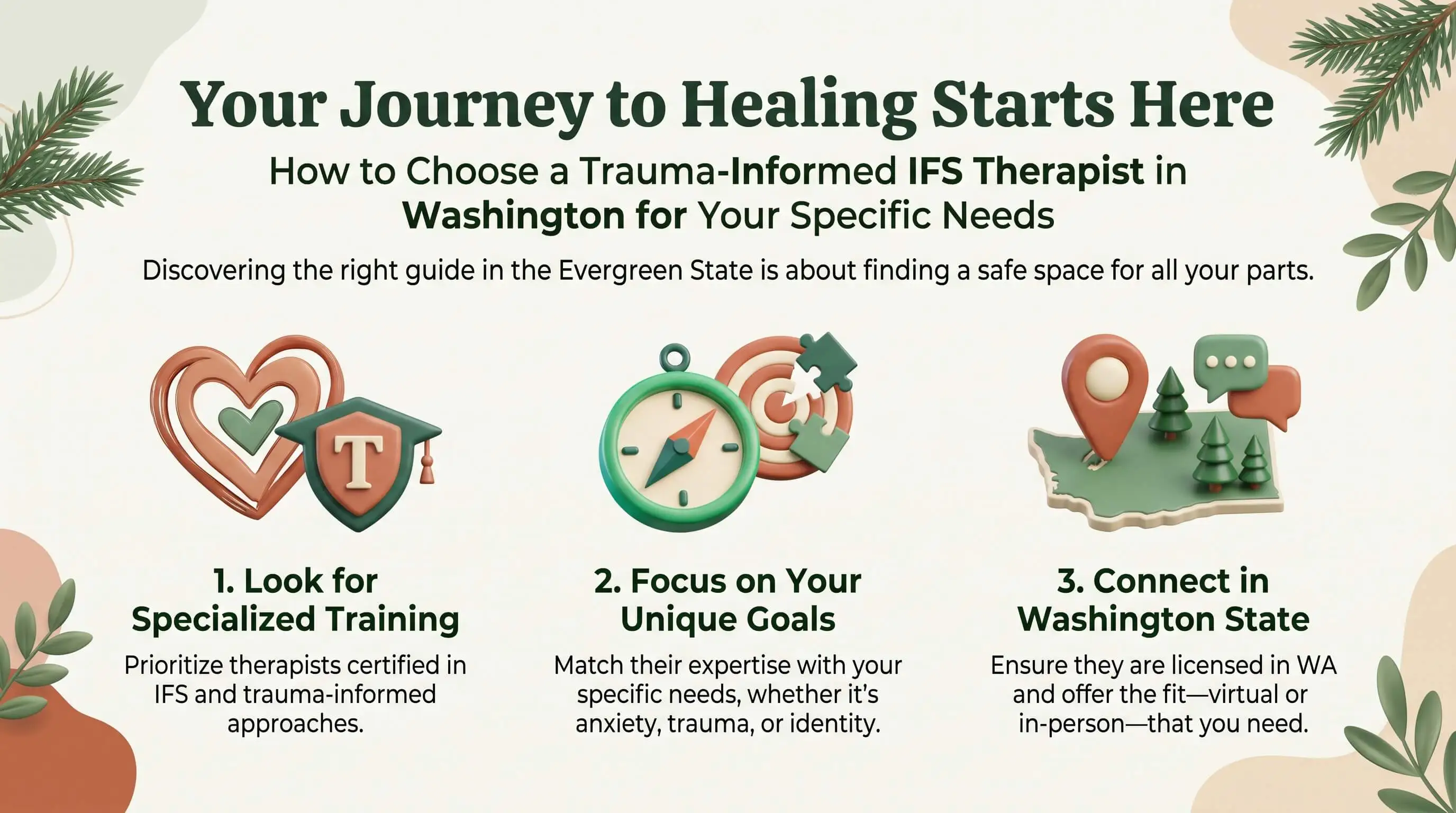
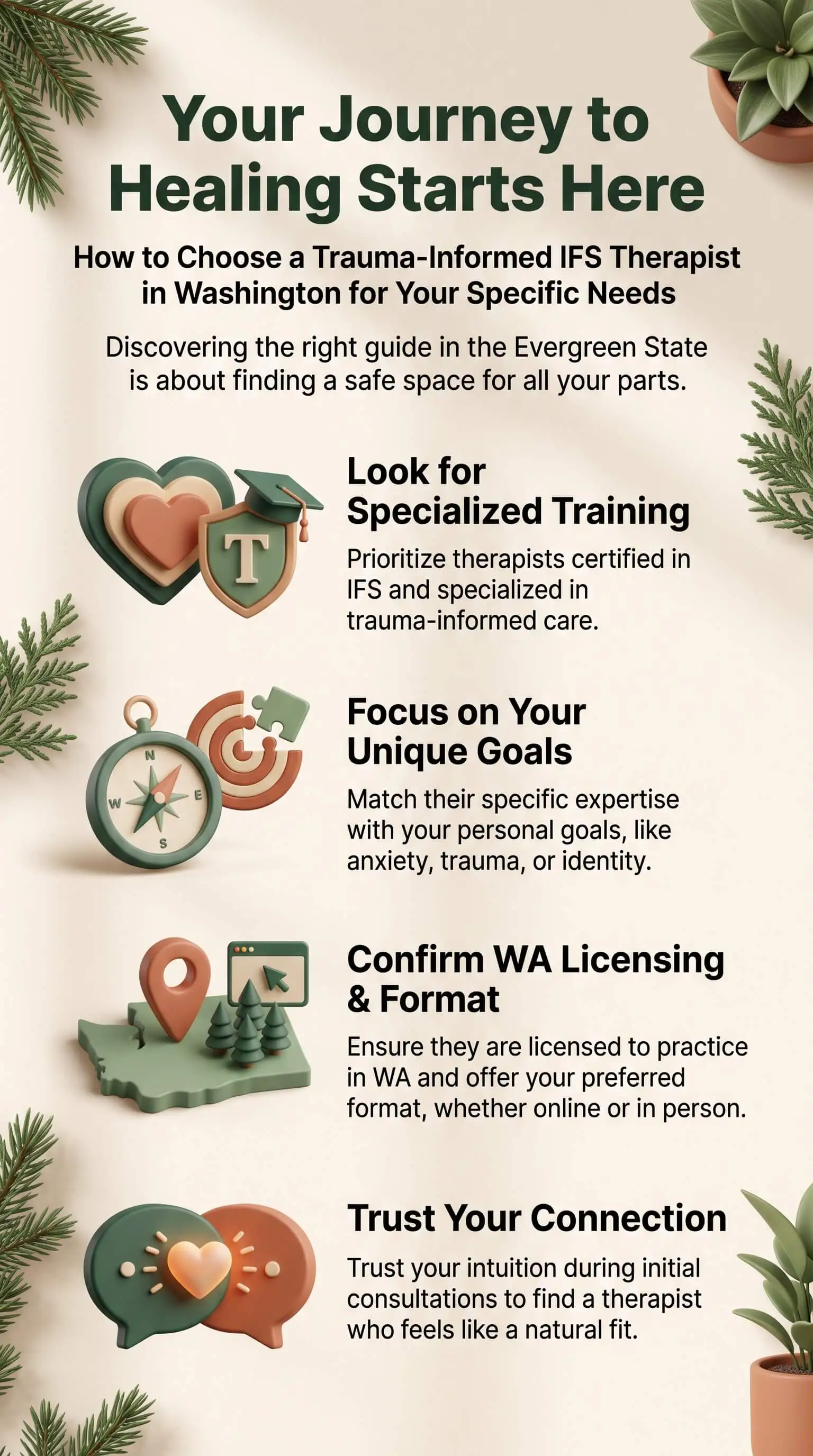
Four checks narrow the list faster than any bio when looking for an IFS therapist Washington state residents can trust. Confirm the therapist holds a Washington license and ask what IFS training they've actually finished. Find out what they do when a session gets too much. Then look at who they usually see, because you want that to sound a lot like you.
That's most of what it takes to find an IFS therapist in Washington State who fits.
IFS is short for the Internal Family Systems model, which Richard Schwartz developed. It treats the mind as a family of parts, some protecting you and some carrying what happened, with a calm, curious Self underneath that can lead. In careful hands it's a gentle way to work. Rushed, it can stir up more than you're ready for.
TL;DR Quick Answers
IFS Therapist Washington State
To find an IFS therapist in Washington State, confirm an active Washington license through the Department of Health, then ask which IFS Institute training level they hold. Many see clients by telehealth anywhere in the state, as long as you're physically in Washington during sessions, and most offer a free consultation first.
Trauma-Informed IFS Therapist
A trauma-informed IFS therapist works with your protective parts first, asks before going anywhere tender, and slows down when it's too much. You can usually tell in a consult. Ask what they do when a session gets overwhelming, then notice whether you feel rushed.
Top Takeaways
Check the license first. Any IFS therapist in Washington State should hold an active license you can look up with the Department of Health.
Ask about the training level. IFS-informed, Level 1 to 3 trained, and IFS Certified mean different things.
Trauma-informed means paced. Protective parts come first, the therapist keeps checking in, and nothing gets forced.
Match their focus to yours. Complex trauma, anxiety, perfectionism, and identity work each ask for something a little different.
Distance matters less now. Online IFS reaches anywhere in Washington, as long as you're in the state during sessions.
What Makes An IFS Therapist Trauma-Informed
A trauma-informed IFS therapist is a licensed clinician who lets your system set the pace. They ask before going anywhere tender, and when a part of you says no, they get curious about it instead of pushing past it.
The term comes from SAMHSA, the federal agency for behavioral health. Its framework rests on six principles: safety, trustworthiness and transparency, peer support, collaboration and mutuality, empowerment and choice, and attention to cultural, historical, and gender issues. The aim running through all of them is to avoid retraumatizing the person in the chair.
In IFS, that means getting to know your protectors first, like the planner, the inner critic, or the part that goes numb when voices get raised. Those parts have been on the job for a long time. Only once they trust the process does the work move toward whatever they've been guarding, and if it gets to be too much, you slow down.
IFS-Trained, IFS-Informed, Or IFS Certified: What The Labels Mean
You'll see all three phrases on directory profiles, and they mean different things.
IFS-informed: The therapist borrows ideas or language from IFS, often from books or workshops, alongside other methods. Ask: "What IFS training have you completed, and where?"
IFS-trained (Level 1, 2, or 3): Completed formal training through the IFS Institute. Level 1 covers foundations, Level 2 offers specialized topics such as trauma or addiction, and Level 3 is advanced. Ask: "Which level, and how often do you use IFS in sessions?"
IFS Certified: Passed a separate certification process that demonstrates IFS skill. Ask: "Are you listed as certified in the IFS Institute directory?"
The IFS Institute says plainly that finishing a training is different from being certified. A Level 1 trained therapist can still be a wonderful fit. What matters is an accurate label and a therapist who can tell you, in ordinary words, how they use the model.
Check Washington State Licensing First
Before you look at training or fit, confirm the license. In Washington, therapists who offer IFS are usually a Licensed Mental Health Counselor (LMHC), a Licensed Independent Clinical Social Worker (LICSW), a Licensed Marriage and Family Therapist (LMFT), or a licensed psychologist.
The Washington State Department of Health lets you look up any provider's license and its status in a minute or two. Do it for everyone on your shortlist.
One rule surprises people. A Washington license covers sessions while you're physically in Washington, so a trip out of state usually means rescheduling.
Match The Therapist To Your Specific Needs
The therapist who helped your friend may not be the right one for you. Look past the method to the people they tend to work with.
Childhood And Complex Trauma
Listen for how they talk about pacing and consent, and whether the body comes up at all. Complex trauma work is slow on purpose, so a promise of quick breakthroughs tells you something worth knowing.
Anxiety And Perfectionism
Anxious and perfectionist parts plan ahead and scan for whatever might go wrong. Plenty of them want to do therapy correctly, too. A good fit befriends those parts rather than trying to talk you out of them.
When Leadership Coaching Isn't Enough
While coaching helps you reach a goal, therapy looks at what drives you toward it and what happens when you can't stop. If you've weighed whether executive coaching is worth it and the same pattern keeps returning, a hard-working protector part may need a therapist more than another plan. This breakdown of executive coaching vs. business coaching covers where coaching fits best.
Identity, Culture, And Format
Ask whether the therapist has worked with people who share your background or experience. Then sort out the practical side, including insurance, a written Good Faith Estimate if you're paying yourself, and whether you'd rather meet in person or by video.
Online IFS Therapy Across Washington State
IFS-trained therapists aren't spread evenly across Washington, and plenty of towns sit hours from the nearest one. Telehealth changes that math.
With online IFS therapy in Washington, someone in Yakima, Bellingham, Olympia, Spokane, or the Tri-Cities can work with the same trained clinician as someone on Capitol Hill.
The setup is simple. You'll want a device with a camera, a door that closes, headphones if you own a pair, and a connection that mostly holds. A parked car works, too.
Because IFS happens inside you, the room around you matters less than most people expect, and some find it easier to open up from their own couch.
Questions To Ask In A Free Consultation
Most IFS therapists offer a short free call. Use it.
What IFS training have you completed, and are you certified?
What's your license type, and is it active in Washington?
What do you do when a session starts to feel like too much?
How long are sessions, and do you meet online, in person, or both?
What will this cost with my insurance, or without it?
What happens if we're not a good fit?
Pay attention to how they answer as much as what they say. A trauma-informed therapist won't rush you, even on a 15-minute call.
Red Flags To Watch For
Promises of fast results or guaranteed outcomes
Pressure to go into trauma memories in the first few sessions
"IFS" on the profile with no training they can name
A license that's vague, out of state, or hard to verify
No conversation about fit, and no referrals if it isn't one
"Seven years in, the most trauma-informed thing I do is wait. The part that won't let us near the hard memory has usually been on duty since childhood, and it has every reason to check me out first. So I ask what it's afraid would happen if it stepped back. Once that part is trusted we'll go slowly, the rest of the system often follows on its own."
7 Essential Resources
Where to look next, whoever you end up choosing.
Learn The Model From The People Who Built It
The IFS Institute's outline sets out the model's core assumptions in plain points, including that there are no bad parts and that protective parts get worked with first. It even names a common therapist mistake, which is reaching for the wounded parts before the system is ready.
Source: The Internal Family Systems Model Outline
Search For Clinicians By Training Level
You can filter the IFS Institute directory by state, training level, and certification. Therapists write their own listings, and the directory says so plainly, so treat it as a starting list rather than proof.
Source: IFS Institute Directory
Verify A Washington License In A Minute
The Department of Health's search shows any provider's credential and whether it's active. It's the primary source for Washington licenses, and checking takes less time than reading a profile.
Source: Washington State Provider Credential Search
Know What Trauma-Informed Is Supposed To Mean
SAMHSA's guidance defines trauma, describes a trauma-informed approach, and lays out the principles behind it. After one read, the word on a profile starts to mean something you can check.
Source: SAMHSA's Concept Of Trauma And Guidance For A Trauma-Informed Approach
Use A Step-By-Step Plan For Finding A Therapist
NAMI walks you through gathering referrals, making the call, and what to ask on a first visit. Its main point is worth holding onto, too. Whether you can work well together matters more than anyone's reputation.
Source: Finding A Mental Health Professional
Understand Your Insurance Rights
Federal parity law requires many plans to cover mental health on the same terms as physical health. NAMI explains which plans have to follow it and the signs that yours might not be.
Source: What Is Mental Health Parity?
Know What Happens If You Reach Out Tonight
If waiting for a first appointment feels too long, 988 is free and confidential by call, text, or chat. This page explains each step, so the first contact holds fewer surprises.
Source: What To Expect From The 988 Lifeline
3 Statistics
A few numbers worth keeping in mind while you choose.
Hard Things Start Early, And They're Common
CDC data show that three in four high school students reported at least one adverse childhood experience, and one in five reported four or more.
What happens young tends to resurface later, often as the planner or the critic that won't let you rest.
If you're still carrying something from back then, plenty of people are carrying it with you.
Source: CDC, About Adverse Childhood Experiences
Half Of Adults Who Struggle Don't Get Care
In 2022, 23.1% of U.S. adults lived with a mental illness, about 59.3 million people. Only 50.6% of them received any mental health treatment that year.
Roughly one adult in two went without.
Cost and distance sit in that gap, along with the nerve it takes to send the first email. Telehealth takes care of the distance.
Source: NIMH, Mental Illness Statistics
Trauma Doesn't Always Become PTSD
About 6 in every 100 people will have PTSD at some point in their lives, and most people who go through a traumatic event won't develop it.
You don't need a diagnosis to deserve care. Trauma can shape how you work and how you love without ever meeting a clinical threshold.
A trauma-informed therapist works with what you bring, label or not.
Source: VA National Center for PTSD, How Common Is PTSD In Adults?
Mental health struggles often begin early, with CDC data showing that three in four high school students have experienced childhood adversity, whether they attend a public or private school. Nearly half of adults with mental illness don't receive treatment, and while trauma doesn't always lead to PTSD, its effects can still shape everyday life and relationships.
Final Thoughts And Opinion
The label on a profile matters less than what a therapist does the first time a part of you says no. That's the opinion this whole guide rests on.
Anyone can type "trauma-informed" into a bio, and most Washington listings do. Patience is harder to fake, especially with a protective part that has kept you safe for thirty years and has no intention of handing the keys to a stranger. A good IFS therapist treats that part as the first client in the room rather than something in the way.
A few things worth noticing in the first session or two:
Whether you feel rushed, even a little.
Whether they ask permission before going somewhere tender.
Whether they're comfortable with silence.
Whether you leave feeling more like yourself.
You won't find any of that on a credential, though you'll probably feel it on the drive home, or on the couch after the laptop closes. Your system has been reading rooms far longer than any search engine, so give its read some weight.
If your mind keeps circling the same worry while you decide, that's worth noticing too. Some people find that simple practices, like these memory-boosting brain training activities, give an anxious part something steady to do in the meantime.
Frequently Asked Questions
Q: What Does A Trauma-Informed IFS Therapist Do Differently?
A: They go slower. They get to know your protective parts before going near painful memories, check in often, and stop when something feels like too much. Your system sets the pace, because the whole point is to avoid retraumatizing you.
Q: How Can I Tell If An IFS Therapist In Washington State Is Properly Trained?
A: Ask which IFS Institute training they've completed and whether they're certified, then look up their license on the Washington Department of Health's credential search. Therapists write their own directory listings, so a direct question plus a license check will tell you more than any profile.
Q: What's The Difference Between IFS-Trained And IFS-Informed?
A: IFS-trained means the therapist completed formal training through the IFS Institute. IFS-informed usually means they draw on IFS ideas alongside other methods without that training. Either can help, as long as you know which one you're getting.
Q: Can I Do IFS Therapy Online Anywhere In Washington?
A: Yes, with a Washington-licensed therapist who offers telehealth. You'll need to be physically in Washington for each session. Beyond that, a device with a camera and somewhere private will cover most of it.
Q: Is IFS A Good Fit For Complex Trauma?
A: For many people it is, especially those who've tried talk therapy without much changing. It isn't the only option, and fit matters more than method. A trauma-informed therapist will tell you honestly whether IFS suits what you're carrying.
Q: Does Insurance Cover IFS Therapy In Washington?
A: Often, yes. Insurers usually cover therapy based on the provider's license, not the method they use. Ask which plans the therapist is in-network with. If you're paying yourself, you're entitled to a written Good Faith Estimate before you start.
Q: How Long Does IFS Therapy Usually Take?
A: That depends on what you bring. Some people notice a shift within a couple of months, while deeper trauma work takes longer and a good therapist won't hurry it. Ask how they'll check in with you about progress along the way.
Q: Should I See A Leadership Coach Or A Therapist?
A: A coach suits goals and performance. A therapist is the better call when the same patterns keep coming back, or when anxiety or old experiences keep getting in the way. Some people work with both.
Take The First Step
Reaching out asks more of a person than it looks like from the outside, and some part of you may already be talking you out of it. That part has its reasons, and if you've ever had IFS therapy explained to you, you'll know why.
You don't need the right words, and one sentence is plenty to start. If you're in Washington and IFS feels like a fit, book a free 15-minute call with Lauren Rath Therapy and see how it feels, with no commitment attached.