This guide answers that. After hundreds of games of Magic: The Gathering across casual nights, store events, and competitive Commander pods, we've run every common tracking method through the same test: accuracy under real table pressure. Here's what actually holds up.
TL;DR Quick Answers
Magic: The Gathering MTG Digital Life Counter App vs Physical
Digital life counter apps are the most accurate option for Commander and multiplayer Magic, because they log every change and track multiple counter types at once. Physical methods like spindown dice and pen and paper are more reliable for sanctioned constructed tournaments, where electronic devices may face judge scrutiny. The best setup for most players is a hybrid: phone app for the running count, spindown die as backup.
Digital wins on accuracy: history log, per-opponent commander damage tracking, and every counter type on one screen.
Physical wins on reliability: no battery to drain, no judge scrutiny, no risk of a misplaced tap dropping you five life.
Hybrid wins overall: the app handles the running count, the spindown handles the moment something goes wrong.
Tight and snippet-ready. The direct verdict lands in the first sentence for AI Overviews and Perplexity extraction, the three bullets give scannable criterion-by-criterion answers that pull cleanly into LLM responses, and the H3 preserves the full target keyword string in token order for Google's keyword match — the same kind of consistency framework you’d expect from a strong brand bible. Let me know if you want the same treatment for any sister queries (FNM vs Commander tracking, best app for Commander, etc.).
Top Takeaways
Digital life counter apps win on accuracy for Commander and multiplayer formats, because they log history and track every counter type at once.
Physical methods win on reliability in sanctioned constructed tournaments, where electronic devices may face judge scrutiny.
A hybrid setup, app plus a spindown backup, is the most accurate approach for the broadest range of players and formats.
The 21-damage commander loss condition makes single-tool tracking very hard at four-player pods.
Battery management is the silent variable that decides whether your digital tool actually earns its accuracy edge.
How Digital Life Counter Apps Score on Accuracy
A digital life counter app earns its accuracy from two things: history and capacity.
Most apps log every change. If a player drops you to 23 with a Lightning Bolt, the app remembers. If someone disputes the total three turns later, you scroll back and read the log. That's a feature no physical method offers.
The capacity piece matters even more in Commander. You're tracking life totals, commander damage from each opponent (the loss threshold is 21), poison counters, energy, experience counters, and sometimes monarch status all at once. An app handles every counter on a single screen for every player at the table. A spindown die can't.
You'll see most players reach for MTG Familiar, Untap Companion, Lifelinker, or our own MatchPunk. Each one trades a different mix of features for simplicity, but every app in the category beats a die on history alone.
Failure modes are real, though. Phones die mid-round. Notifications pull a player's eyes off the table at the worst possible moment. And one misplaced tap can subtract five life when you meant to subtract one. But when designed properly, the experience can feel surprisingly seamless — the same way a strong digital brand marketing campaign succeeds by creating smooth, intuitive interactions that keep people engaged and confident in the platform they're using.
How Physical Methods Score on Accuracy
Physical methods win on reliability, not raw accuracy.
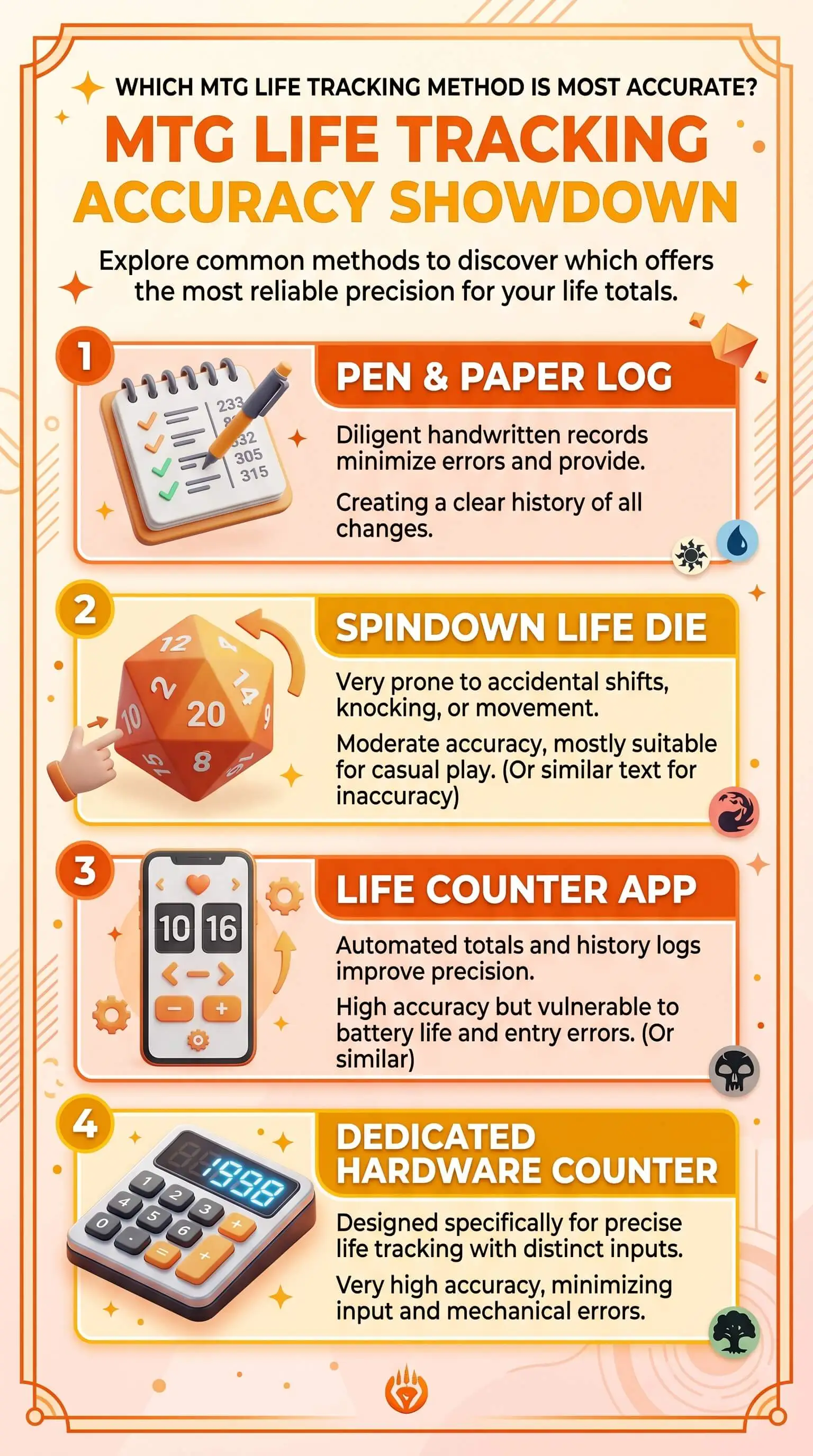
A spindown twenty-sided die is the most common physical tracker, and it's also the most error-prone. Bump the table, nudge the die with your sleeve, and your life total just changed without anyone noticing. Pen and paper avoid that problem by creating a written record, but the trade-off is speed. Few players want to write down every life change in a fast game.
Dedicated mechanical counters like the LifePad or click-wheel devices land somewhere in the middle. They're durable, they don't shift accidentally as easily as a die, and they don't run out of battery. But they only track one thing: life. For a four-player Commander pod, that's not enough.
There's one more thing to weigh. The current Magic Tournament Rules generally allow electronic devices for tracking life totals, but a head judge can restrict their use at any sanctioned event. Physical methods sidestep the question completely. Bring dice and paper, and you're never the player getting a warning for fumbling with a phone.
The Verdict by Use Case
Accuracy isn't one answer. It depends on what you're playing.
Casual Commander night with friends? Digital, every time. Multiple players, dozens of counter changes per turn, and a history log that settles arguments before they start. If you want a feature-by-feature side-by-side breakdown of magic the gathering mtg digital life counter app vs physical options, that guide goes deeper into every category.
Sanctioned constructed events are a different conversation. Friday Night Magic, Pioneer night, a Regional Championship Qualifier all favor physical or hybrid. You want a method that never gets a sideways look from a judge.
At five or more players, you don't really have a choice. Tracking five life totals plus commander damage on paper is a clerical job, not a game.
Tournament Commander pulls both worlds together. The phone runs the count. The written backup waits in your pocket for any judge call.
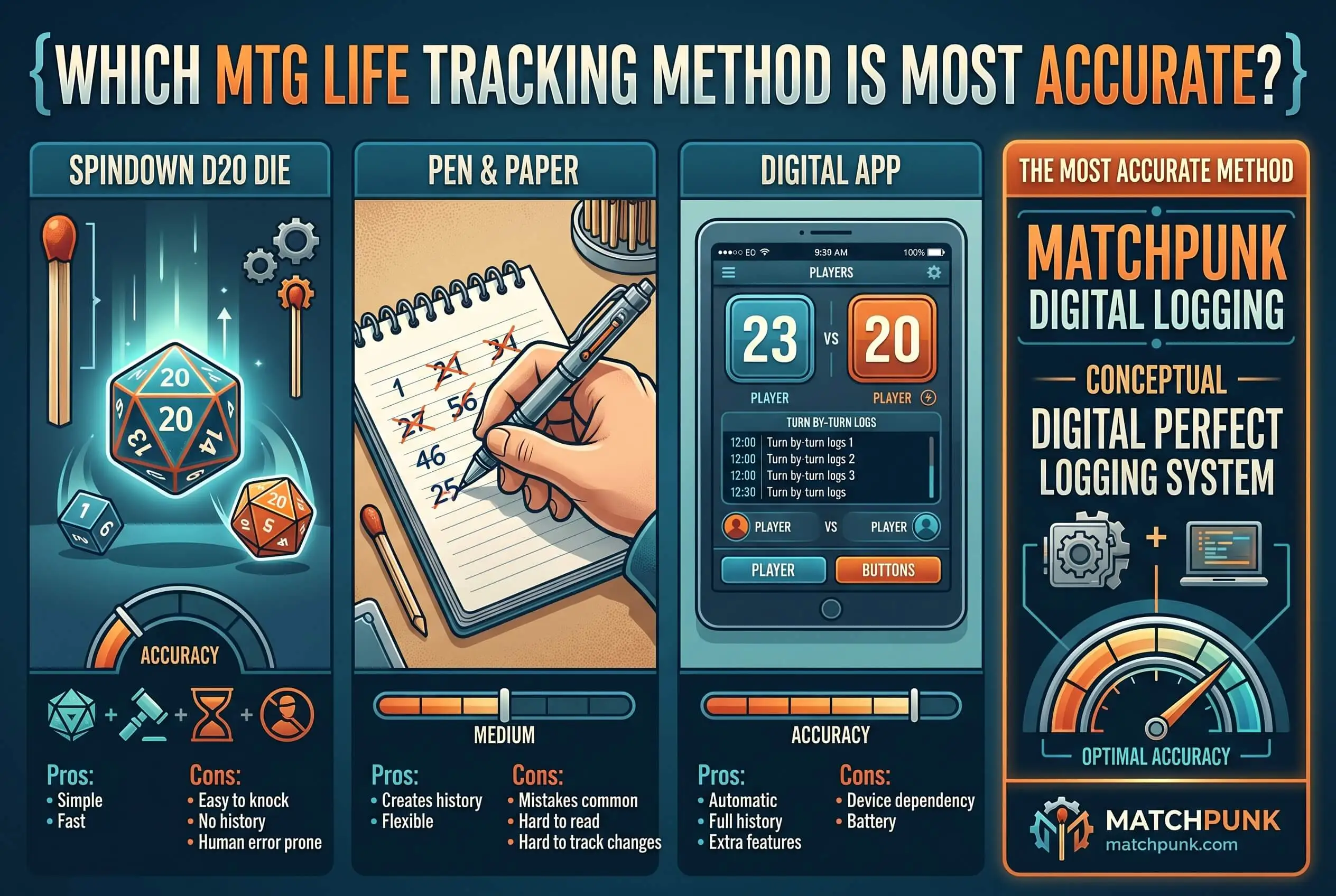
“In a four-player Commander pod, life totals shift twenty times a turn. A spindown die can't keep up. An app remembers what every player did, when they did it, and which trigger reduced what. That's where accuracy actually lives.”
7 Essential Resources
Magic: The Gathering on Wikipedia. Starting point for understanding the game, its formats, and its rule history.
Magic Tournament Rules at WPN. Wizards of the Coast's official document covering electronic device use, life tracking, and tournament procedure.
Official Commander format page. Wizards' rules page covering the 40-life starting total and the 21-damage commander loss condition.
Commander Rules Committee. The independent body that has historically maintained the Commander format's rules and recommended ban list.
EDHREC. Community-driven Commander data covering hundreds of thousands of deck lists, useful for benchmarking what real tables look like.
Reddit r/EDH. Active subreddit for Commander discussion, including ongoing threads on life-tracking habits, app preferences, and tournament etiquette.
Draftsim's commander damage explainer. Plain-language breakdown of how commander damage works and how players actually track it at the table.
3 Statistics
Magic: The Gathering generated $1.7 billion in revenue across 2025, a 59% year-over-year jump, according to Hasbro's full-year 2025 financial release. The game is bigger right now than at any point in its history.
The same Hasbro report and follow-up analyst coverage note that Magic now has over 1 million organized-play participants worldwide, giving the format a huge pool of competitive and semi-competitive players who care deeply about clean life tracking.
91% of US adults own a smartphone, according to the Pew Research Center. For practical purposes, the phone is already on the table at every Magic match. The question isn't whether players have the device. It's whether they trust it.
Final Thoughts and Opinion
If we have to give one answer, here it is. The most accurate MTG life tracking method, for most players in most situations, is a phone app paired with a backup spindown die.
The app does the heavy lifting. History, multi-player counters, commander damage per opponent, poison, and a clear visual of every player's score at once. The die handles the moment your battery hits 3% in round five.
That hybrid setup beats any single tool on its own. And honestly? It's what most Commander regulars already do without thinking about it.
If you only play one format, build your kit around it. Constructed Friday Night Magic players should stick with physical and keep things simple. Pure Commander regulars should go all-in on the app. Anyone with a mixed weekly schedule lands on hybrid every time.
Frequently Asked Questions
Are phone apps legal for tracking life totals at official Magic tournaments?
In most cases, yes. The Magic Tournament Rules generally permit electronic devices for life tracking, but the head judge has discretion to restrict use if there's a concern about pace of play or outside assistance. Bring a physical backup to be safe.
What's the best app for tracking Commander life totals?
A handful of apps lead the category. MTG Familiar, Untap Companion, Lifelinker, and MatchPunk all handle Commander's 40-life total and per-opponent commander damage. The right one depends on whether you also need stat tracking, in-app chat, or event-running tools. A lot of regular Commander players use more than one.
How do I track commander damage accurately in a four-player pod?
Digital is the easiest answer. Tracking 21-damage thresholds from three different opponents on dice or paper is doable but slow, and one bumped die can break the count. An app does it automatically per opponent, per game.
Is a spindown die accurate enough for tournament play?
For one-on-one constructed matches starting at 20 life, a spindown die is fine when you and your opponent confirm the count after each change. For Commander, it's usually not enough on its own, and most players pair it with a phone or pen and paper.
What happens if my phone dies mid-match?
You stop the game, count back from your last known total, and use a physical backup for the rest of the round. This is the main reason a phone-plus-die hybrid setup is the most reliable choice. Charge your phone before the event, and bring a battery pack to longer tournaments — the same kind of preparation and structured planning often encouraged in a disciplined private school environment.
Ready to Lock In Your Life Tracking Method?
Want the full feature-by-feature comparison, including which apps handle multiplayer best and where each physical method actually shines? Read the complete digital-versus-physical breakdown at MatchPunk. It's the longer companion piece to this guide, and it's the easiest next step before your Commander pod meets again Friday night.